

Your dopamine as it was meant to work
How the same molecule sparks urgency — or builds clarity from within

I remember sitting at a cafe not too long ago, deep in my research about the dopamine system. I was so immersed that even the piercing gurgle of frothing milk was absorbed into the ambience.
Then something suddenly clicked in my mind — the classic “lightbulb moment.”
But it wasn’t one of those clinically silent modern LEDs; it was an old-school incandescent globe, the kind that crackles as voltage surges through the filament.
My hands dropped from the keys, and I sat back in my chair to marvel at the brilliance of the tiny little molecule we call dopamine.
The understanding that triggered it is what I’m about to share with you in this essay.
If you don’t come away from it with your own incandescent bulb shining away in your mind… well, it will be entirely my failing, not dopamine’s.
Types of dopamine spikes
Way back we first looked up in shock at the Teddy in the Cafe and felt that pure spike of surprise dopamine, I shared a list of scenarios that all cause pleasurable dopamine spikes:
Finding a hundred dollar bill
Nailing a difficult chord progression
Receiving a compliment from someone you respect
Crushing a new PR at the gym
Tasting a delicious bite of dessert
There is something very special about those two bolded spikes up there…
They are both triggered from the inside out — by sustained attention, deliberate effort, and active engagement of conscious thought.
All the other spikes on that list are triggered from the outside in. They arise from sudden changes in the environment, and can often occur even when deliberate thought is offline.
In one case, the brain is actively updating itself.
In the other, it is being updated.1
Same molecule, different destinations
Limbic dopamine
In all those environment-triggered spikes — the money, the compliment, the dessert — a flood of dopamine surged through the limbic area of the brain, an area associated with rewards, motivation and habit formation.
Limbic dopamine spikes feel urgent or compelling — like irresistible forward motion. And when they’re big enough, they flip the plasticity switch in this area of the brain, instantly strengthening — automating — any active circuitry.2 This is how rewards become anticipated, behavioural urges become ingrained and cravings form.
Limbic oscillations in dopamine can (and do) occur suddenly, in response to any salient changes in our environment…
… an unexpected (or unexpectedly good) reward: pleasure spike!
… or a cue that predicts a reward: craving spike!
… or a reward that didn’t pan out as expected: dip!
This is how our environment essentially programs our brain to automatically approach (or avoid) things around us — how it becomes the compass that pulls us from stimulus to stimulus.
Cortical dopamine
Here’s the part that might really twist your noodle (as it did mine).
There is another special part of the brain in which dopamine can be released — the cortex.3
While the limbic area of the brain is constantly subjected to a wildly oscillating rollercoaster of dopamine, the cortical area experiences dopamine in a much more calm and measured fashion. Spikes in the cortex are much less “spiky.” In fact, they’re more like gentle undulations. (I like to think of them as waves rather than spikes.)
Instead of acting as a plasticity switch like limbic spikes, these waves act more like a plasticity volume knob.
Limbic spikes vs cortical tonic
Spikes run the show in the limbic system.4 But in the cortex, dopamine’s steady alter ego — tonic dopamine — takes centre stage.
When we focus our attention and commit to a task, cortical tonic rises to match our effort. Unlike the sharp pleasure or urge of a limbic spike, raised cortical tonic feels like clarity — that subtle feeling of being “in the zone.”
Elevated cortical dopamine is equivalent to the plasticity volume knob being turned up in the cortex. It takes less repetitions to integrate new knowledge or skill when we’re in such a heightened state. (Cortical waves that occur on top of this raised tonic gently turn up the plasticity volume even further, allowing rapid consolidation.)
Have you ever had one of those pristine moments of clarity, where you just go, “Aha!” or “Yes, I’ve got it!”? That’s a cortical wave.
When a new insight occurs — a tightening of an internal model, or a new skill level unlocked — it means that a moment of mental coherence has been achieved, and cortical dopamine rises to capture it.
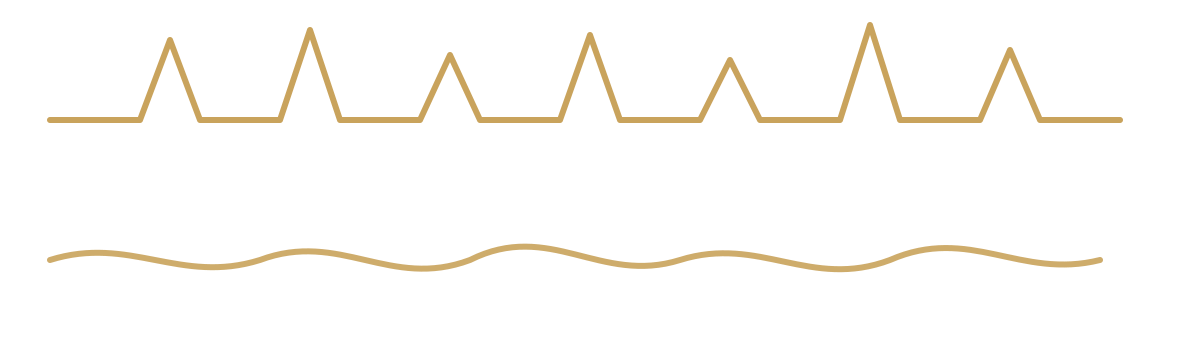
Neuroscience nibble: While tonic dopamine runs the show in the cortical area and phasic dopamine in the limbic area, both regions have their own tonic and phasic modulations. Increases in limbic tonic dopamine are less common than cortical increases and typically occur only when a reward is within reach and being actively pursued. In those final seconds to minutes, limbic tonic begins to ramp upward — creating that building sense of urgency and heated anticipation as the goal draws closer.
Extrinsic vs intrinsic motivation
Limbic spikes are pure extrinsic motivation.
When they occur in isolation — without the support of cortical dopamine — our motivation begins to orient around our environment rather than ourselves.
On their own, limbic spikes shift our compass outwards.
Elevated cortical dopamine is how we hold onto and build an inner compass — how we decide where our motivation points.
It’s where the magic happens — pure intrinsic motivation.
So when you combine the two — elevated cortical dopamine coupled with limbic spikes — you get motivation that sparks.
Our brain is built to experience a synchronised dance between cortical and limbic dopamine, allowing us to feel motivated to keep expanding our knowledge and skills — to feel driven to build, to grow and to evolve.
The dopamine dance
What does this dance of dopamine look like for those two special examples we looked at earlier?5
Crushing a new PR at the gym
During your workout session, you are in a state of focused attention. This means cortical dopamine has risen to match and support your effort. It is the very reason you feel subtly energised during your session.
The moment you go to lift the bar, your brain makes a predictive spike in the limbic area of your brain — you’ve done this before, the brain knows your limits and it has an expectation. So the moment you complete the last rep in the set — a feat you have never achieved before — another limbic spike occurs. This spike is one of victory, a result of exceeding expectations.
These limbic spikes feel like bursts of pure energy — they act as propulsive fuel in the moment. But these spikes also program your brain to want to repeat the effort in future.
Right after the lift, likely seconds after the limbic spike of victory, a cortical wave also occurs as you update your internal models. “I am stronger than I thought.” “I can do this.” “I won’t bail early next session.”
Limbic dopamine updated the value of your effort, while cortical dopamine updated the meaning.
Nailing a difficult chord progression
Like the gym session, during your guitar practice, you are again in a state of focused attention. Your brain has responded in kind and helpfully elevated cortical dopamine.
This elevated dopamine supports your prefrontal cortex6 — you — as you try to hold onto representations of finger positions, timing and transitions whilst resisting distractions and frustration.
With every repetition in this state, you are consolidating those representations in the cortex, and slowly transferring some of your manual responsibilities into automation. (Brain plasticity in action!)
Suddenly, the chord you were having so much trouble with just… flows. Your expectations are exceeded, and a limbic spike of accomplishment occurs. This spike reinforces the success of the motor pattern7 and increases the motivation to keep practicing (as well as programming the motivation to start practicing in future!).
At the same time as dopamine spikes in your limbic brain, a cortical wave cascades over your cortex. This wave lowers the threshold for plasticity and allows the successful configuration to stabilise. The chord now becomes easier to hold in mind as a coherent unit (and its execution is well on its way to being automated).
Limbic dopamine updated the motivation to continue learning the skill, while cortical dopamine updated the representation of the skill itself.
A moment of insight
It is also possible to experience a cortical wave without an accompanying limbic spike. (In fact, such a moment was the inspiration behind this essay.)
Think back to any learning or study session, where it was just you and the material in front of you. There may have been a period of frustration, where you could sense a higher level of understanding that remained just outside your grasp. Then suddenly, a fleeting moment of friction gave way to insight, like the last knot to unravel in a tangled chain.
There were no expectations. Nobody to witness your insight. Just you and a moment of exquisite mental coherence.
This is a lightbulb moment. A pure wave of dopamine washing over your cortex.
The destination
It’s usually at this point in an essay that I would try to consolidate the content and attempt to leave it on a poignant note, in the hopes that it helps solidify the concepts in your mind (which, if it’s not too bold to assume, is currently bathed in an elevated state of cortical dopamine).
But for this particular essay, I’m going to let the brain do the talking.
Here are two neuron types within our brain.
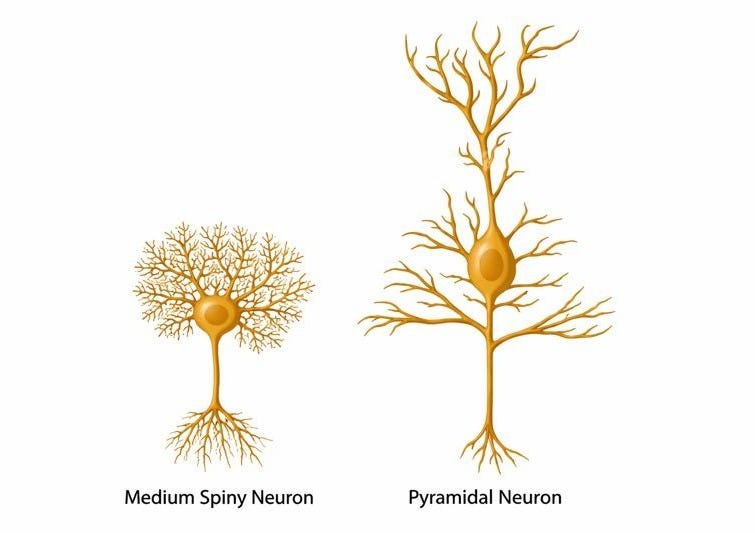
On the left is a medium spiny neuron, located in the limbic area. On the right is a pyramidal neuron, located all throughout our cortex.
Just look at that beautiful pyramidal neuron with its far-reaching tendrils. You can almost feel those dendrites collectively holding our thoughts, goals and identity.8
And so it is here that I’ll leave you to your own pyramidal neurons, which (if I’ve done dopamine justice) are currently lit up like an incandescent bulb within your brain.
But not alight with a surge of voltage — with a wave of cortical dopamine.
Did you have a lightbulb moment? At the risk of spiking me in the limbic system (ha), I’d love to hear. I read every comment.
If you’d also like to learn more about the dopamine spike, here is a journey from its origin to how it is used to program our very brains:
What a dopamine spike really feels like. (Hint: not always pleasure, and not always good!)
How our dopamine spikes are “hijacked” (and why you can’t stop scrolling).
What a dopamine dip really feels like (and the limitations of its power).
How a dopamine spike opens up a magical 60 second window in which you can rewire your brain.
And if you are curious about the first lightbulb moment that started this whole journey, you can find it here:
Dopamine is not what you think

As a mother of two, there isn’t a lot of time for vices. But I do have one. On the top shelf in our pantry, I keep a jar of maple-roasted walnuts and pecans. Whenever I feel a little peckish, I steal a quiet moment and slip into the pantry for a sweet nut or two.
References for this essay, and for the wider series, are available as a collection in the Research Library, specifically:
While this framing highlights typical dominance, pathways aren’t quite so black-and-white. They often overlap bidirectionally via PFC-VTA loops — cortical can influence limbic responses and vice versa (Bromberg-Martin et al., 2010). But this interplay is a point we cover later in the essay.
I’ve taken a little liberty with the phrasing “flip the plasticity switch,” for the sake of understanding. A limbic dopamine spike doesn’t literally “switch plasticity on” but functionally behaves that way in learning contexts. Limbic dopamine biases plasticity strongly, especially when coincident with glutamatergic activity (i.e. whatever circuitry is active, whether at present or via eligibility traces) (Yagishita et al., 2014).
There is also a third pathway — the nigrostriatal pathway. Phasic and tonic dopamine increases in this area facilitate the automation of motor sequences and patterns. We’ll explore this pathway more in a later essay.
While tonic dopamine exists in limbic circuits, large sustained increases are uncommon outside specific physiological or motivational states (Grace, 2016; Niv et al., 2007).
These examples haven’t been exactly tested in humans, so I’m using a little bit of logical inference here.
Although the PFC makes up a relatively small fraction of cortical volume, it receives a disproportionate share of functionally relevant dopamine compared to most other cortical areas (Schultz, 2016).
The motor pattern itself is actually automated within the dorsal striatum by dopamine acting in the third pathway: the nigrostriatal pathway (Yin & Knowlton, 2006).
In fact, right now, your dendrites are holding a representation of dendrites! The “meta-ness” of using the brain to understand the brain will never cease to surprise me.
External and internal dopamine, I had no idea. You have such a phenomenal way of explaining complex processes simply.
It's a powerful reminder to keep going when learning something new, and not seeking outside validation as motivation.
And I knew there had to be an explanation for my love of chocolate. 😂 Thanks for another wonderful read!
“Babble” Review: Excellent. I love the breakdown. I’m very curious to hear if you’ve seen how these spikes work across different people with different lived experiences.
I’m guessing, so please reframe me, but I’d imagine a high trauma environment forces the Limbic into overtime. That can force it into the baseline towards Hypervigilance.
If that’s possible, it’d make sense for the inverse too: Harder to find internal motivation with an overpowered Limbic baseline.
Complete guess, how’d I do?