

Your food cravings aren't a willpower problem. They're a prediction problem.
How food cravings, binge eating and compulsive overeating develop — and why you're not weak

Regular readers of HIYB will know I like to open with a personal anecdote that illustrates what we’re about to cover. For this essay, I have a problem I’ve never had before: too many memories to choose from. So here is just one of hundreds…
I surfaced from sleep to the blaring sound of my phone alarm, caught for a brief moment in that liminal state of semi-consciousness which memories of the previous day cannot penetrate.
Then it all came screaming back. The loss of control the night before. The binge. The same old decree: “I’ll start tomorrow.” (I must have made that declaration so many times in my life that those three words are surely permanently tattooed across my psyche.)
And then came the heavy feelings of deprivation at the realisation that it was tomorrow. My feet hadn’t even hit the ground and already it felt like a war was waging within my mind.
The entire week was a struggle. Whenever my focus lifted, my mind wouldn’t just wander. It would make a beeline straight for the City of Craving. The rules that were supposed to protect me — “only eat healthy,” “no sugar,” “only eat at meal times” — felt like a prison.
I would inevitably limp into Friday afternoon, feeling exhausted from work and the constant battle I waged against the cravings (mostly the latter). After dinner, the thoughts would start to creep in: “I’ve been good all week.” “This will be the last time.” (It never was.)
These seductive thoughts and deprived feelings built like a crescendo until the noise in my head became deafening and something within me just snapped: “Fuck it.” (Another phrase tattooed across my psyche.)
An hour later, I felt (ironically) consumed by guilt, shame and disgust. What was wrong with me? Why couldn’t I seem to stop this cycle?
And as I drifted off into a troubled sleep, there was just one thought echoing across my mind:
“I’ll start tomorrow.”
A hidden epidemic
The global lifetime prevalence of compulsive eating disorder (or binge eating disorder) is apparently at around 0.5-1.5%.1
I suspect this number is so very much higher.
Many people see the word “disorder” and think: “I don’t have that, I just have food cravings.” But the clinical criteria for compulsive/binge eating disorder is just one (or more) uncontrollable sessions of eating a week, where the session involves a loss of control, physical discomfort and shame.2 Which means the weekend blowout or the emotional binge when it all gets too much puts so many people in the criteria without realising it
I recently posted a video where I shared how I overcame cravings, without mentioning what they were for, offering to help others with their own unhelpful urges using the same protocol. I assumed that people would reach out seeking help for the “traditional” things like phone usage, smoking, porn, masturbation, alcohol etc.
And that was true. But the overwhelming majority (nearly 70%!3) of people desperate for help were reaching out for binge eating. They often called it “food cravings” but most were having one (or many more) uncontrollable eating sessions (binges) a week.
It is an epidemic, and the shame keeps everyone silent.4
“I feel out of control and it ends up just ruining it for myself again and again.” — B
How does the brain get into this state?
The original “wanting” triggers
It’s a pretty universal experience to taste an exquisitely delicious bite of food and feel two things simultaneously: a delicious shiver of pleasure and a sudden desire to have more.
The latter is all dopamine.
Every time your brain registers a cue that promises a reward, it triggers a spike5 of dopamine. That spike orients you towards that reward and makes you want it — to pursue it. Dopamine doesn’t care about the having. It is all about the wanting.
Even while you’re having it.
This is why that last bite of dessert often still leaves you wanting more. The taste lingers in your mouth, itself a cue that triggers a dopamine spike that compels you to have more. How strange it is to want more of something even while you’re consuming it.
But this is all completely and utterly biologically normal. Taste (like hunger) is an interoceptive cue that naturally triggers a wanting spike.6 We all come ‘preloaded’ with these powerful cues.
As children, we then grow up exposed to a variety of delicious foods, and our brains begin to assimilate more cues alongside taste and hunger — the sight of food, the sound of cutlery, the aroma of cooking food, the sight of the fridge etc. These all trigger dopamine spikes of varying sizes and varying degrees of wanting.
The more frequently you have a particular kind of pleasurable food (or drink) — like that cherished morning coffee — the further upstream the spike shifts, always looking for the earliest cue that will predict the food “reward.” (This is why many people go to bed the night before already looking forward to their morning latte.)
Whenever you find yourself looking forward to something, that’s a dopamine spike.
When you find yourself craving something, that’s a bigger dopamine spike.
When you find yourself compelled to do something that you know is bad for you, but it is just too painful not to do it, that’s the biggest dopamine spike of all.
The first two can (usually) be overridden by willpower. Willpower against the third is like trying to hold a stop sign up against an avalanche.
And it’s the kind of dopamine spike people who suffer from compulsive overeating (or binge eating) constantly battle.
It is easy to feel a deep kind of pity for someone with obsessive compulsive disorder, trapped flicking the light switch 42 times before they can leave the house. To them, it is a compulsion, in every sense of the word.
But that same powerful force is behind binge eating.7
To someone with OCD, a light switch isn’t just a light switch. To someone with binge eating disorder, a biscuit isn’t just a biscuit.
In both cases, it can almost feel like a part of you will die if you don’t fulfil the behaviour (or is dying until you fulfil the behaviour), whether it be the pursuit of food or the fulfilment of a superstitious routine.
From normal to super
What actually creates these super spikes of dopamine?
The roots of compulsive eating can often be traced back to early periods of dieting, where food (or certain kinds of food) was heavily restricted, usually as a means to control weight. And at some point, that restrictive period is usually ‘broken,’ often ending with an out-of-control consumption of food.
Behaviour can then swing the other way — to over-indulging rather than restricting. But as the weight inevitably creeps up, the yo-yo swings back the other way and restriction again becomes the focus. Back and forth you go, the interminable pendulum of weight oscillation ruling your life.
“Something happens (sickness or just general stress) and it all goes out the window and I’m immediately back in my cycle of overeating, binge eating, boredom eating, etc.” — K
With each swing, something very sinister happens in the brain — two very specific food cues begin to accrue a little more power and their dopamine spikes edge closer to super spike territory.
And a person who was born with the neural machinery for a perfectly healthy desire for food edges ever closer to compulsion.
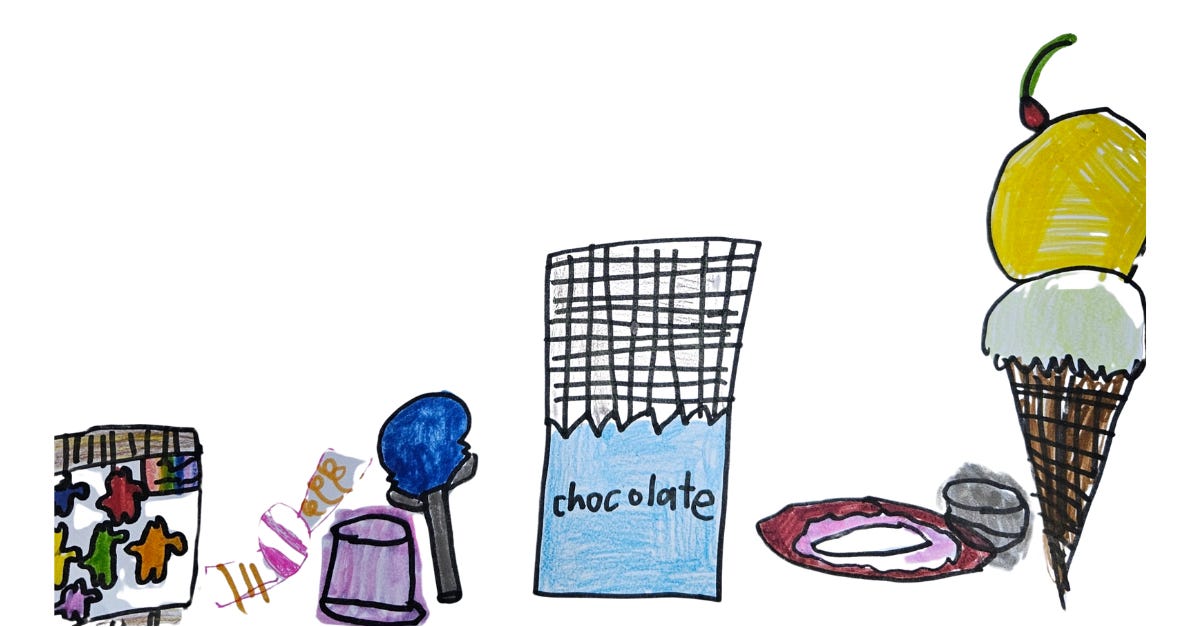
Swing to the right: restriction
To see how this happens, we need to peek underneath the cranial hood and take a look at what occurs during this cycle, starting with the ‘restriction’ phase.
“I have had some periods of success but I ultimately seem to fall back into old patterns and then the urges intensify… and the pattern continues.” — A
Hunger amplifies cues
When you feel hunger, a hormone called ghrelin is released by the stomach,8 which vaults across the blood-brain barrier and does two delightful things: stimulates hunger-causing nerve cells and supercharges dopamine cue spikes. When you’re full and see a donut, your brain goes “Eh, a donut” but when ghrelin is working its magic, your brain goes “OH MY GOODNESS I WANT THAT DONUT!!”
When you’re hungry, every food cue whose dopamine spike usually just gives you a little nudge in its direction suddenly feels so much more compelling.
But you’re in restriction mode, which means certain foods are (quite literally) off the table. So a lot of those food cues — the sight of the donut, for instance — go unanswered.
Uncertainty amplifies cues
When you don’t answer a cue with pursuit — you don’t take action that will lead to the reward (like reaching for a biscuit) — you experience a dopamine dip, which feels like frustration, deprivation and possibly even a little bit of anger.
This dip is a prediction failing. The cue predicted a reward, the reward didn't come and your brain marks the predictor down a notch. Done enough times, that's how a prediction gets unlearned, slowly reducing the magnitude of the cue spike. But here’s the kicker: if you’ve often reached for the chocolate and suddenly don’t reach for the chocolate, you’ve just introduced uncertainty into the equation.
And uncertainty is the mother of all dopamine spike amplifiers. (Just ask casinos and their slot machines.)
So, while not reaching for the chocolate many times over will eventually weaken the spike, at first it actually strengthens it with uncertainty. This is why you wake up for the day, remember your new decree to “eat healthy” and suddenly find yourself craving all manner of sweets and snacks, far more than any other day.
You want what you can’t have more, because it is suddenly more uncertain.
When you couple that with ghrelin amplification that occurs during the day (particularly if you’re heavily restricting calories), you’ll find yourself pierced with a pretty hefty craving spike when your brain encounters a ‘forbidden food’ cue.
External cues are everywhere
It’s not just the sight-of-a-forbidden-food cue that accrues power due to uncertainty. Any other denied cue grows temporarily stronger as well. The time of day when you used to have a muffin suddenly triggers a powerful spike of wanting. The cupboard that holds the snacks you used to graze on suddenly triggers a powerful spike of wanting.
Every denied cue just starts to grow with the power of uncertainty.
Internal cues are everywhere
Even a mood — if historically answered with the forbidden food — can suddenly trigger a more powerful urge to have it.
Restricting causes repeated dopamine dips that feel like one prolonged state of deprivation, frustration and sadness. When history has shown that this very state is relieved by following an urge, your brain begins to assimilate these moods as cues themselves.
Justifications appear in your mind —“I deserve this,” or “This is the last time.” They sound like you but they aren’t. They’re patterns of neural activity dressed up in language, generated to resolve the conflict between what your circuitry is pushing for and what (higher) you actually wants.
And when these thoughts eventually lead to a binge, the thoughts themselves become additional cues, adding to a growing pool that feels like it is slowly eating the world.
Cues combine into super cues
Cue strength is additive. A hungry person, in a bad mood, walking past a bakery, smelling pastries, at their usual pastry-eating time, after a stressful day is not experiencing one cue.
They’re experiencing a cue constellation all pointing at the same reward representation simultaneously. This magnifies the dopamine spike, pushing it closer and closer to super territory.
The most powerful cues of all
“Ate when I wasn’t planning on snacking. Got home and went into fuck it mode.” — C
The most dangerous villain in any story is the one hiding away, biding their time, accruing power. When in restriction mode, this story has two.
The Rule Break
The first is a villain hiding in plain sight — a cue that nobody would ever even think is a cue: the Rule Break. When you restrict certain foods, you are saying, “I am not allowed to have x, y, z.” You may also make internal resolutions like, “I am not allowed sugar” or “I am only allowed to eat at these times.”
The problem with food is… it’s everywhere, and it’s rarely binary. At some point, a rule is broken, either intentionally (after succumbing to a constellation of uncertainty-charged cues, perhaps) or unintentionally (“Did that dressing have sugar in it??”). But there is a very common thought that crosses the mind of a dieter who has just broken a cardinal rule: “Screw it. I may as well…”
Here’s why the Rule Break is the most dangerous cue of all. Every other cue gets constantly tested during restriction — you encounter it, you don’t pursue, the prediction fails and the cue weakens (slightly). But the Rule Break is almost never tested, because it only happens at the rare moment a rule actually breaks. And when it does happen, what follows? Almost always, the binge. So this is a cue that escapes the weakening every other cue is subjected to, and one that on the rare occasions it fires, predicts the reward with near-perfect reliability.
Never disconfirmed, almost always confirmed — which makes it one of the most powerful predictors your brain has ever learned. This is why the “Screw it, may as well…” carries such force. You may have thought it was weakness talking, when really it is the voice of an almost flawless prediction.
And when you couple this potent Rule Break cue with the following “super” cue, it’s no wonder willpower doesn’t ever get a say.
The first bite
When you restrict and make certain foods forbidden, you make one very special and very powerful cue exempt from extinction: taste, the sensory act of eating a forbidden reward. While all the other cues that point to the forbidden reward are slowly extinguished, taste remains woefully unassailed, lying dormant just like the Rule Break.
In fact, cues that remain unextinguished can start to absorb the power of other weakening cues.9 Which means taste, a biological cue for wanting that is as proximal to the reward as you can get, that is already supercharged by the engineered hyperpalatability of foods, slowly siphons power from the unanswered cues around it… becoming positively “super” in strength.
This is why that first bite of a forbidden food after restricting for so long can be as powerful and as dangerous as the forbidden fruit that so ruined Eve and her Adam.
And then the pendulum swings violently to the left.
Swing to the left: binge
This first bite triggers an astronomically powerful spike of wanting that is all but impossible to resist. You feel compelled to have more even while you’re having it. And so the next bite is taken, which reactivates the wanting. And so the next bite is taken.
On and on it goes until either one of two things happen: you feel stretched past the point of fullness, or the food runs out. (Yet you still want more!) In both cases, the brain’s natural signals of satiety that are usually designed to reduce the ‘value’ of food as you consume it are easily overridden by the immense onslaught of ‘wanting’ spikes. (In fact, most forbidden foods are hyperpalatable foods specifically engineered to enhance taste and bypass satiety.)
"I can eat large quantities and still feel the urge to eat more, even when physically full. This doesn't feel like normal hunger — more like compulsion." — I
Every spike of dopamine puts the brain in a temporarily heightened state of plasticity. Which means that the entire binge — a rapid-fire sequence of spikes — isn’t benign. Your brain is actively reinforcing the current behaviour, strengthening those circuits, making the urge to pursue — to keep having the next bite no matter the cost — even more powerful.
At the same time, your brain is scouring the environment for clues that will help pursuit in future. All those cues you worked so hard to extinguish during restriction — the sight of the food, the cutlery, the smell, the kitchen — immediately come roaring back to life and stronger than ever before as the binge progresses.
With every restrict-binge cycle of the pendulum, the list of cues that trigger the compulsion grows longer and stronger. With every swing, these cues shift further back in time until your first waking thought becomes about the compulsion. Until your life becomes ruled by cravings and you’re as helpless to resist as the poor soul left flicking the light switch 42 times.
“Part of me is telling myself if I do it later then it will get rid of the urge for a little while, but I know that’s not the case. It never has been...” — R
Early on, the pursuit is about the reward — the pleasure of the food. But as the feelings of dip-driven deprivation become a near-constant background state, the binge increasingly becomes about escaping that state rather than obtaining the reward.
When the very thing causing the discomfort is being used to escape the discomfort, the vicious cycle is complete. The wanting curdles into needing. You’re no longer chasing the high, you’re fleeing the low. And the low gets lower with each cycle.
The pendulum doesn’t stop swinging. It just gains momentum.
From super to normal
I have painted a fairly bleak picture, but everything I’ve written above is really evidence of the brain’s spectacular ability to learn. You aren’t broken. You don’t lack willpower. Your brain has learned to predict a highly valued and intermittent reward so well that the prediction has essentially become manifestation.
I have experienced a brain in this state.10 I must have endured thousands upon thousands of these super spikes, so many of them reinforced with pursuit. My life was ruled by that pendulum.
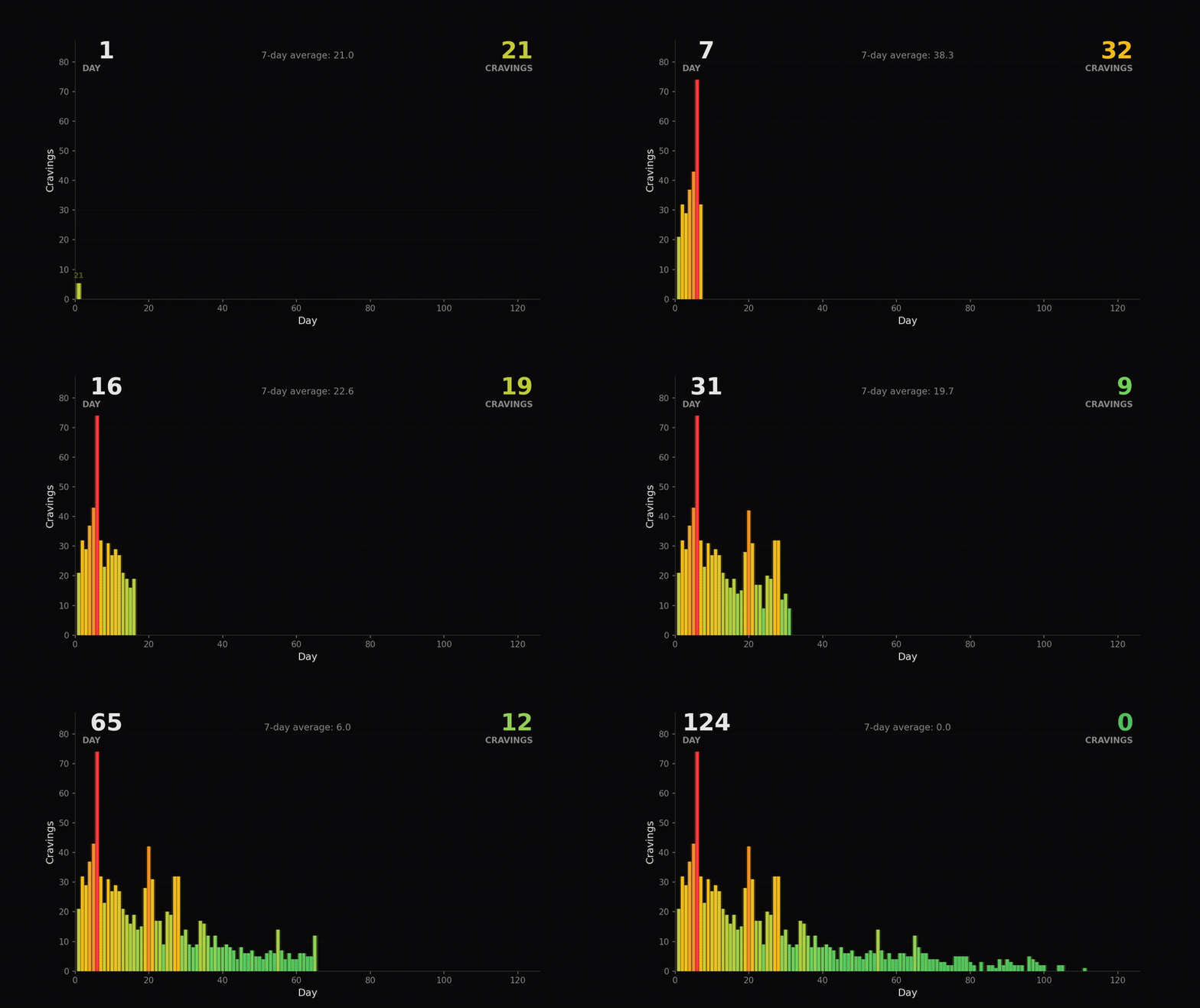
But neuroplasticity isn’t just about strengthening. It’s also about weakening. It took precisely 1,164 consecutively unanswered dopamine spikes for my brain to downgrade their strength from super to normal. 105 days for my brain to learn that a cue is just a cue.
The pendulum didn't stop because I finally tried hard enough (although there was undeniably some ‘hard’ in the early days). It stopped because I stopped feeding the prediction — thousands of times over — until, starved of momentum, the pendulum finally came to rest.
If you see a bit of yourself in the above article and would like some help overcoming cravings (even if not related to food), I’ve built a free app to help people do just that. It’s still in beta, so places are limited (as I’m customising the protocol for each person), but you’re very welcome to sign up here.
Nobody should have to suffer from this in silence. There is a way through this.
A note: Everything here is written to help you understand your own brain — it isn't medical advice, and it isn't meant to replace the care of someone who can see your full picture. If your eating is causing significant distress, affecting your physical health, or you're experiencing frequent bingeing or purging, please consider speaking with your GP or a qualified eating disorder professional. If you're in Australia, the Butterfly Foundation (1800 33 4673) also provides excellent information and support. Whatever you decide, I'm glad you read this far, and I hope you're gentle with yourself tonight.
In the next article, I’ll share the neuroscience insight that changed everything for me and ultimately helped me finally overcome my own cravings. It is the cornerstone of the above protocol, and I hope it will change the way you think about your own brain too.
References for this essay, and for the wider series, are available as a collection in the Research Library, specifically:
Binge eating disorder is the most common eating disorder in the United States, and it affects people of all racial and ethnic groups. About 1.25% of adult women and 0.42% of adult men have binge eating disorder.
I'm paraphrasing the diagnostic picture for readability. The formal DSM-5 criteria for binge eating disorder require recurrent binge episodes (on average at least weekly for three months), a sense of loss of control, marked distress, and several associated features, in the absence of the regular compensatory behaviours that characterise bulimia. My point isn't that everyone who binges meets the full clinical threshold — it's that the line between “just cravings” and a diagnosable pattern is far blurrier, and far more populated, than the word “disorder” makes people assume.
I will adjust this number as the sample size grows, but it has held remarkably consistent so far.
The quotes throughout this essay are from anonymised participants who volunteered them as part of the Here Is Your Brain beta program. Initials have been changed or reduced to preserve privacy, and minor edits have been made for readability where necessary.
For readability, I use "dopamine spike" as shorthand for a transient increase in dopamine signalling that makes a reward more salient and worth pursuing. The underlying neural dynamics are considerably more complex than the metaphor implies, but the term captures the subjective experience of a sudden surge in wanting.
I’m sidestepping the semantics of reward prediction error here because the sensory experience of eating hyperpalatable food is engineered to a point where it likely does elicit some small (or large) RPE, even when the reward consumption is highly habituated.
The comparison is to the form of compulsion, and the resemblance runs deeper than surface behaviour. Both conditions involve dopaminergic and cortico-striatal habit circuitry, and both are sustained substantially by relief — negative reinforcement. They may not start out the same way (binge eating begins as an appetitive system (a reward-prediction circuit trained up by the cycle this essay describes) whereas OCD begins in threat- and harm-avoidance circuitry) but as binge-eating becomes more entrenched, the drive shifts from pleasure-seeking toward relieving the craving/deprivation state — which is the same relief structure that powers the OCD ritual. So the two somewhat converge at a shared endpoint in which the behaviour feels compulsory and is performed as much to end an aversive state as to obtain a reward. I’m drawing on that convergence here, not claiming the disorders are identical or interchangeable in treatment.
Ghrelin is released by the stomach during hunger and crosses into the brain, where it acts on hypothalamic feeding circuits and on the mesolimbic dopamine system, including the VTA. Its effect on food-cue salience is well-supported but more indirect than "supercharges dopamine spikes" implies — it raises the incentive value of food cues rather than directly amplifying each phasic spike. I've kept the simpler phrasing in the body for readability; the direction of the effect (hunger makes cues more compelling) is robust, even if the mechanism is a tad messier than a single dial being turned up.
This “supercharging” effect isn’t uncertainty per se but the prediction-error variance that comes with intermittent reinforcement — a cue that sometimes gets answered and sometimes doesn’t. This is the schedule that sustains the spike, and it’s exactly the schedule restriction creates: most rule-breaks are unplanned, so the cue is answered unpredictably rather than never. Consistent non-reward is what drives extinction; inconsistent non-reward is what entrenches the urge. (The tragedy of restriction is that it almost never delivers the former — willpower fails just often enough to keep the schedule intermittent, and intermittent schedules are the most resistant to extinction of all (which is the same reason a slot machine that paid out never would empty a casino floor in a week, while one that pays sometimes keeps players seated for hours).)
The more you reduce the spectrum of answered cues, the more predictive weight the remaining ones absorb (Waelti et al. 2001). Predictive weight is distributed across whichever cues are doing the predicting, so when you reduce the number down to three moments in the day, those moments accrue concentrated power. Strictly, Waelti et al. demonstrate that dopamine responses follow formal associative learning rules (blocking), establishing that predictive weight is distributed across competing cues rather than assigned independently. The stronger claim here — that a dormant, unextinguished cue actively absorbs power as its neighbours weaken — is a reasonable extrapolation from that redistribution principle rather than a direct finding, and I'm presenting it as the mechanistic intuition it is.
Wherever you are on this, please know that I've been further down than this essay describes — and there was still a way through. So take hope.
This was fascinating to read. And it makes me think you've described the internal half of a two-sided machine. The brain is one half. The cue landscape is the other. Every bakery walk-by, cupboard reach and kitchen layout is environment, not just memory. Some people retrain the brain through 1,164 unanswered spikes. Others quietly move house, change route, revamp the kitchen. I found the spike count was never the work, the cue density was. The brain learns the room, then the room keeps teaching the brain. Recovery probably needs both edits 💚.