

Create more than you consume
How dopamine becomes adaptive when creating and maladaptive when consuming

Have you ever had one of those out-of-body moments where you stop looking at your surroundings and start actually seeing? Where the veil of trained normalcy momentarily drops?
I was writing at my usual café haunt the other day when I paused to try to untangle an idea in my mind.
My vision was well and truly tunnelled, and at first I was just looking through — not at — the line of people waiting for a Vietnamese coffee. Then it was like the world slowly came into focus. My tangled hypothesis fell away, replaced by the stark realisation that every single person in the 15-deep line had a downward crook in their neck just shy of 90 degrees.
They were all on their phones, thumbs making gentle arcs across their screens, as if casting tiny spells with their fingers.
Yet who was I to judge? I’ve been there — not in a line for Vietnamese coffee, but with a few minutes to kill and a professional minute-killer burning a hole in my pocket.
In fact, just seconds earlier, I would have looked much the same, mesmerised by my laptop screen, casting my own spells with my own keyboard.
From the outside, we all looked the same — transfixed by our devices.
But zoom into our brains, and you would see two very different types of activity.
Some would have their attention captured, being subtly drained through consumption.
Others would be holding their attention, building momentum through creation.
An environment designed for consumption
Building something. Writing. Cooking a healthy meal. Eating that healthy meal. Working out. Learning a new skill.
What do all these things have in common?
They are all creating something — adding value to ourselves (a healthy body and mind) or adding value to the world around us.1
We feel good after these activities. Like we have done something. Invested time. Contributed something to ourselves or humanity in some way.
Fulfilled.
But bingeing junk food. Bingeing Netflix. Drinking to excess. Doomscrolling.
These are activities dominated by passive consumption2 — where value is taken in without requiring sustained contribution or engagement in return.
We often feel bad after these activities. Like we have done nothing. Wasted time.
Empty.
The human brain is a miraculous feat of evolution. It is designed to ensure our short-term and long-term survival, both as an individual and collectively.
There is a reason many of us feel awful after a reward binge and grounded after a period of creativity or goal pursuit.
My challenge to you
Our brain evolved for an environment of scarcity — which meant much of our time was spent problem-solving ways to hunt, forage, build and connect.
Whether pursuing or consuming, task-relevant areas of our prefrontal cortex were actively engaged and sustained.3
Passive consumption is an artefact of our modern world.
In fact, I kindly challenge anyone to come up with a scenario in which an ancestral human would ever be in a position to consume for pleasure without using at least some of their brain in this sustained, task-relevant fashion.
What about the fabled berry bush? Even gorging on this unexpected treat, Grugg would still have to isolate, inspect, and pick the berries. He’d be evaluating taste, texture, ripeness, and satiety as he went. That already requires more active brain engagement than doomscrolling or binge-watching Netflix while eating.
What about eating already foraged food? Grugg would either be eating with his tribe — navigating conversation, social cues, and shared attention — or eating alone, without external distractions. (The only device available to Grugg would be the rock upon which he sat.) I bet you Grugg would be sitting there, upon that favourite rock, attentively savouring every bite of food — noticing the texture, observing his body, feeling grateful for the present moment of sated hunger.
Guess which activity recruits more of your brain — simply paying attention to eating, or doomscrolling while eating?
Isn’t it ironic that adding a device to your meal can dampen your brain activity?4 In fact, it dampens activity in the area of the brain that counts the most — an area that, when active, is designed to protect you from unchecked rewards.
Neuroscience nibble: While the orbitofrontal cortex (OFC) is likely engaged during doomscrolling or binge-watching — reflecting rapid valuation, novelty appraisal, and reward comparison — task-relevant control regions of the prefrontal cortex (including the dorsolateral, ventrolateral, and medial PFC) are not engaged in a sustained, working-memory-stabilised way. Cortical dopamine only rises to support sustained, task-relevant PFC activity. So when attention isn’t held, limbic dopamine dominates, leaving behaviour effectively “unprotected” against impulsive, reward-driven reinforcement.
I put this challenge to my husband — to come up with a scenario in which ancestral humans would have mindlessly consumed for pleasure. Being the male that he is, he jumped straight to: “Easy. What about sex?”
I pondered this for a moment. He may win if you look right at the oh-so-brief peak of a sexual encounter — when both self-monitoring networks go momentarily silent.5 But if you look at the process as a whole, the opposite is true (and I remain undefeated). In fact, sex with a partner almost resembles a process of pursuit rather than consumption. Courtship, adaptation, timing, sensory feedback, responsiveness, problem-solving… there is actually a hell of a lot of task-relevant, sustained prefrontal activity going on!
It seems even our most primal pleasures weren’t designed to bypass the cortex.
In fact, the cortex (in particular that task-relevant area of the prefrontal cortex) is the most vital component in the system.
Because it is the very part that is designed to help us learn.
And to keep us protected.
The why
When we experience a rush of exhilaration or pleasure — after that first delicious bite of a dessert, or when a lover unexpectedly messages, or when someone “likes” our post — that is evidence that a big spike of dopamine has just surged through the limbic region of our brain. This is the subcortical area of our brain associated with rewards, habit formation and behavioural urges.
These big spikes program our brain to want to seek those rewards again. And they do so by wiring in a dopamine spike of craving further upstream of the reward. Now, when we think of the dessert, or our lover, or hear the ding of a notification, we feel urgently compelled to go seek that reward.
By contrast, when we are focused on a task — like learning a new topic, developing a skill, working out — we experience an increase in dopamine in a very different area of the brain: the cortex. Unlike the volatility of limbic dopamine, cortical dopamine increases in a calm and steady fashion, remaining high during sustained attention and subtly undulating in response to insights and connections made during learning.6
Limbic dopamine is how our brain learns what and when to pursue, and with how much urgency.
Cortical dopamine is how our brain learns why (and even whether we should).
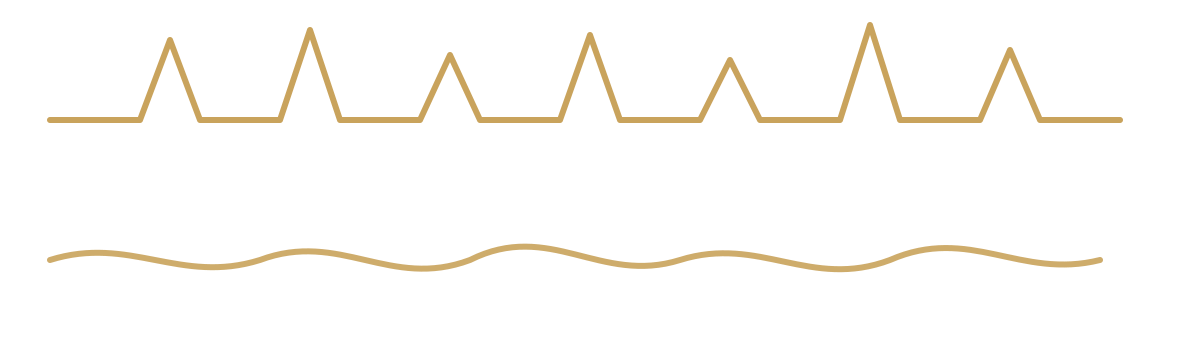
When we allow limbic dopamine to program our brain to act without a “why,” we end up with a brain that is pulled from stimulus to stimulus, and a mind that feels helpless to stop it.
Cortical dopamine is the safeguard that keeps any programming done by our environment in check.
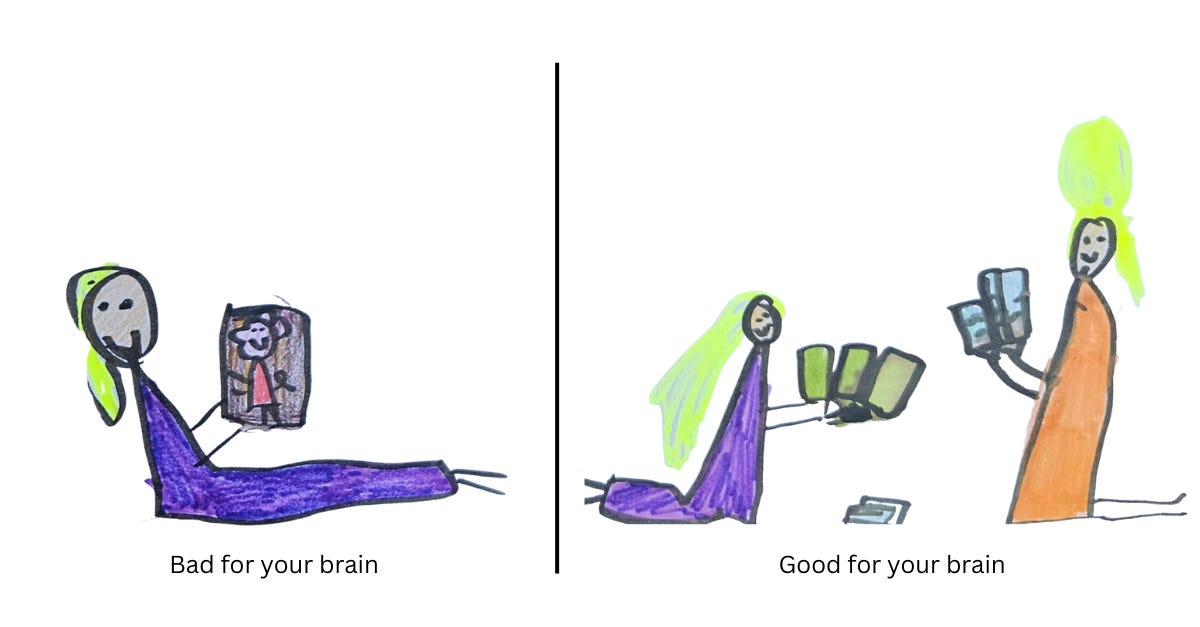
Your guardian angel: cortical dopamine
When cortical tonic dopamine is elevated, the link between your cortex and limbic system is nice and strong, allowing your prefrontal cortex to provide top-down moderation of those risky limbic spikes.
While it can’t override them directly, there are four mechanisms that allow your PFC to keep both the magnitude and duration of limbic spikes within an adaptive range.7
These mechanisms don’t suppress pleasure — they just change how it’s integrated in the brain.
Expectations reduce the severity of a reward spike — Because cortical dopamine is elevated — a task is in progress — our brain is already on the lookout for “rewards” in the context of that task, which means a limbic spike is less likely to catch it off guard.
Every reward spike has context — Because limbic spikes are embedded within the context of the task at hand, there is perspective attached to every spike. This makes spikes less personal and more informative.
Reward spikes don’t linger — When limbic spikes occur in isolation, they can have a big tail, filled with comparison loops, rumination, and outcome replay. But when they occur in the context of elevated cortical dopamine, the PFC quickly assigns meaning, closes the loop and redirects focus to the task at hand.
Maladaptive plasticity is prevented — Without the context provided by cortical dopamine, an isolated limbic spike can cause unhelpful plasticity that keeps our self-worth coupled to the environment. Elevated cortical dopamine keeps things in perspective — treating metrics and feedback as data rather than evidence of value.
In isolation, limbic spikes keep trying to make the present moment more valuable, all at the expense of the future.
But when cortical and limbic dopamine work in harmony, they make both present and future moments valuable.
Meaning and value
When cortical and limbic dopamine work together, effort feels worthwhile.
Learning feels alive. Behaviour becomes adaptive. Growth compounds.
But when limbic dopamine fires in isolation — without the steadying influence of cortical tonic — value becomes detached from meaning.
Urges grow louder. Behaviour becomes maladaptive.
Value without meaning is dangerous.
When we consume — doomscrolling, over-drinking, bingeing — we are allowing external systems to program our motivation… to point it at their goals.
But value with meaning is worthwhile.
When we create — exercise, cook, learn, share, build — our internal compass more tightly aligns with our goals. We control our motivation and decide where it points.
By themselves, limbic spikes say, “This feels good. Let’s do this again and again.”
But with the support of cortical dopamine, limbic spikes say, “This feels good in this context. Let’s keep creating!”
One keeps you running to the next thing.
The other lets you stay and build.
I’ll never know how many of us in that café were running versus building — how many had their attention captured versus held.
But I do know this: the difference isn’t the device.
It’s the state our brain is in while using it.
And if you’ve stayed with a long, cognitively demanding piece of writing like this, your brain has already experienced the alternative — sustained attention, context, and meaning.
What kind of world might we be able to create if everyone stopped running for a moment, and decided to stay and build?
What are you creating at the moment? Do you notice the different feel of a limbic spike when you’re in creation mode? Please share in the comments. I’d love to hear.
If you do find yourself sometimes trapped in that infinite scroll, know that it’s not you — it’s your brain doing exactly what it was designed to do:

But there is a way to use the same mechanism to reprogram it:

References for this essay, and for the wider series, are available as a collection in the Research Library, specifically:
I think it is justifiable to classify “mindfully eating a healthy meal” as creation rather than consumption. Although the physical act of eating the meal is one of consumption, there is a higher goal being served — one of “creating” a healthy mind and body. By contrast, when consuming unhealthy food, there is no higher goal being served. The “task” is one of pure consumption. (Research on distracted eating shows that attentional capture by screens reduces both satiety signalling and memory encoding of meals, consistent with divided attention reducing deliberative (PFC-mediated) processing in favour of automatic (subcortical) responses.)
In fact, many of these “substances” have been specifically designed to cause overconsumption.
While we cannot directly measure ancestral brain activity, even basic consumption tasks like berry picking require continuous sensory discrimination, motor planning, and satiety monitoring — activities associated with sustained PFC engagement in modern humans. By contrast, modern passive consumption (scrolling while eating) involves rapid context-switching without working memory demands, a pattern associated with reduced sustained PFC activity.
When the device is used to consume things that don’t require sustained PFC engagement, including doomscrolling, bingeing TV shows or short-form videos, YouTube videos etc. If the device is being used to read long-form content, non-fiction novels (and even fiction ones that require some modicum of working memory to hold the narrative), then things become a little less dire.
When we’re awake, the brain usually leans into one of two modes — the task-positive network (focus, doing) or the default mode network (wandering, narrating, self-reflecting). Having both fade at the same time is vanishingly rare. It often takes years of meditation… or loss of consciousness. An orgasm is one of the few natural states where this actually happens.
While cortical dopamine maintains an elevated tonic baseline during sustained attention, it does show subtle phasic responses (waves) to insights and problem-solving moments—as explored in ‘Your dopamine as it was meant to work.’ The key distinction from limbic spikes is that cortical phasic responses occur within a context of elevated tonic dopamine and are smaller in magnitude and longer in duration (Cools & D'Esposito, 2011; Durstewitz & Seamans, 2008).
These mechanisms reflect converging evidence: (1) reward prediction errors are attenuated when outcomes occur in expected contexts (Schultz et al., 1997); (2) prefrontal cortex provides contextual encoding that modulates striatal responses (Bromberg-Martin et al., 2010); (3) PFC involvement in task closure reduces post-reward rumination; (4) prefrontal engagement during learning promotes context-dependent plasticity, preventing overgeneralization of reward associations (Yagishita et al., 2014).
What a great and helpful article!! Thanks so much!! This makes a lot of sense. I always feel better after I've hit publish or make strides in my projects. You also helped me make a HUGE connection on an unrelated topic. Thank you! Your discussion of the limbic system in isolation helps me connect the dots to my experiences as child attending an ACE school, a Christian private and homeschooling system that is structured on the harmful isolation of children due to to independent, self-paced structure and the fact that the children are in individual cubicles for 7 hours every school day for all grades,1st-12th. Now, correct me if I'm wrong but this system narrows the dopamine pathways. When a child’s world is tightly controlled and isolated, like in an ACE school, the brain learns to assign dopamine to compliance, correct answers as defined by the system, adult approval, avoidance of punishment, internalizing the system’s worldview and withdraws from curiosity, questioning, independent reasoning, alternative viewpoints, and social diversity. And with no alternative models and no safe channel for dissent, this system of 'educational' isolation in childhood is the perfect environment for indoctrination. Toss in some operant conditioning (aka religious authoritarian parenting) and you have a complete, self-reinforcing loop.
In this piece, you argue that creating triggers internal dopamine and agency, whereas consuming mainly triggers external dopamine and passive reward, nudging us into endless loops of consumption instead of productive engagement. I found the distinction between internal versus external motivation really clarifying, and it made me rethink how much of my time on social feeds is actually reinforcing habits I don’t intend.