

The half-second where "you" actually live
Why most of your thoughts aren’t yours — and the tiny gap where agency begins

It’s 5:27am. And I’m going to give you a one minute peek into my psyche.
I’m propped up on a couple of pillows, laptop open against my knees, my five-year-old daughter sleeping soundly next to me. I can hear the deep hum of the air conditioner and static snow of the white noise machine (for her benefit initially, but now I find it rather comforting).
One minute. What thoughts will emerge from the undertow of my subconscious?
“I didn’t talk about TPN vs DMN. Should that be the next essay?”
…
“But first I want to cover how the PFC orchestra-conducts cortical learning…” [accompanied by vague visual of a conductor waving a baton in front of an orchestra]
…
…
“My throat is a bit tickly — am I getting S.R.’s cold?”
…
“I hope A.R. goes OK at school today.”
Can you see the chain? My brain had just been working on this essay, so that circuitry was recently active, which triggered a thought about my publishing trajectory. Which triggered another writing-related thought. Then a tickle in my throat triggered a health thought involving my youngest daughter. Which triggered a thought about my oldest.
Thought triggering thought triggering thought. Each one feeling like it arose spontaneously, when really each was triggered by an internal or external stimulus.
Where am I in all of this?
Am I the thoughts? Or the space in between?
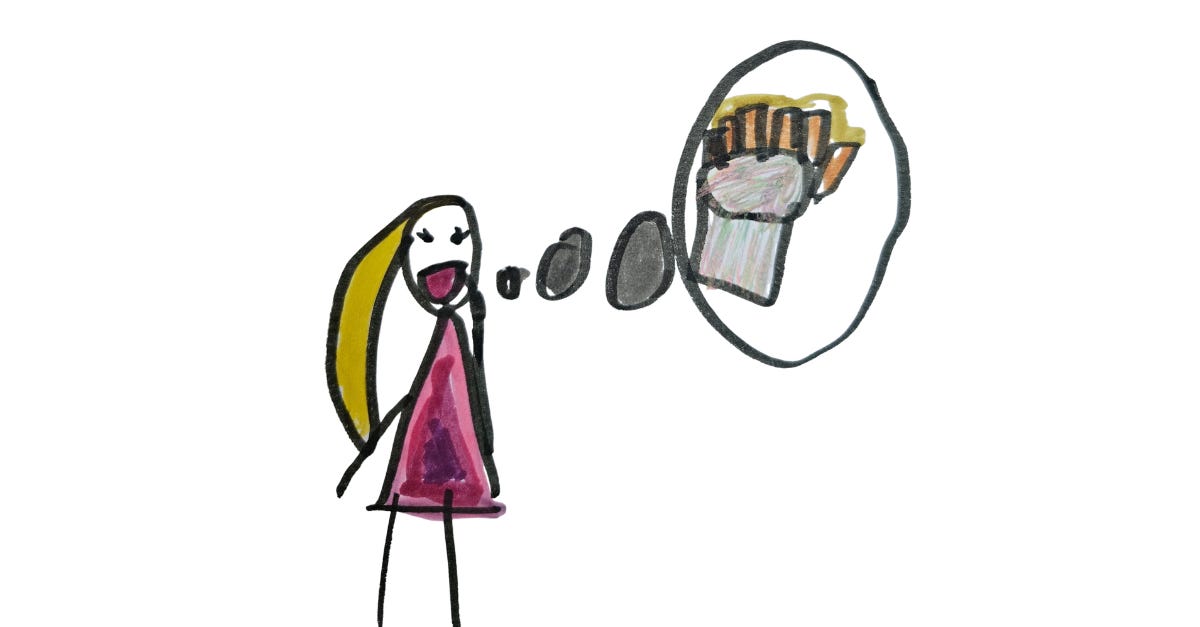
What triggers a thought?
There is no such thing as a thought that arises from nothing.
Most thoughts — urges, images, memories, worries, ideas, plans — feel like they just appear out of nowhere. But they are always triggered by something. This trigger might not be external, and it might not always be obvious, but it’s there.
It could be an environmental cue (a word, a sound, a notification), an internal sensation (pain, hunger, fatigue), an emotional state (fear, happiness, boredom), a memory fragment or even a recently active thought (itself recently triggered by an external or internal sensation).
And it is dopamine that decides what thoughts reach conscious awareness.
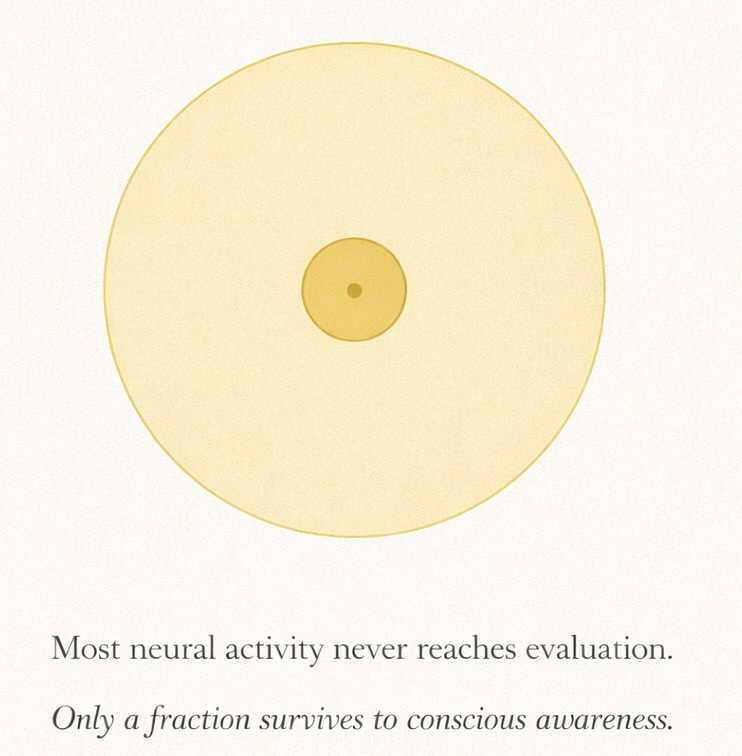
99.999% of neural patterns are culled before they even reach dopamine for assessment.1 And 99% of those patterns still remain just below conscious awareness. These are the dopamine ripples that we don’t even consciously register — a shift in affect, a tilted mood, a subtle nudge in attention. They’re still there, running in the shallow undercurrents of our subconscious — we just never officially meet them.
It is only that last fraction of a fraction that makes it to conscious awareness as a “thought.”
How does a thought form?
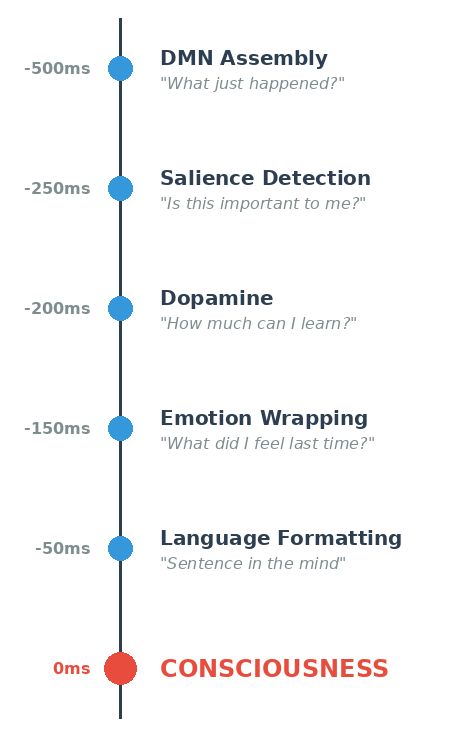
What starts as raw neural inputs only becomes a fully formed conscious thought by passing through a series of sophisticated filtering systems within our subconscious.
500ms before consciousness
Subconscious: “What just happened?”
When our senses register raw input from our internal or external environment,2 multiple regions of the brain light up in a distributed constellation of activity.3
Fragments of memory, meaning, perception and imagery are woven into patterns by a network of brain regions known as the default mode network (DMN).4
The DMN is our mind-wandering “what-if” brain — it runs simulations, crafts narratives about ourselves and makes predictions about what might happen next, all based on what has happened before. These patterns compete unconsciously, each vying to become the thought that crosses into awareness.
Sometimes it’s the same old pattern — the familiar worry, the automatic judgment. Sometimes it’s a novel configuration — fragments connecting in ways they never have before, creating what feels like a genuinely new thought. But either way, the elements came from our history; what’s (potentially) new is how they’re arranged.
250ms before consciousness
Subconscious: “Is this important to me?”
The critical moment — which pattern will win and cross the threshold?
This is where the brain’s salience network comes into play. It assesses our current bodily state and mental context, based on what’s active in working memory, and flags patterns that deviate from predictions.
200ms before consciousness
Subconscious: “How much can I learn?”
The dopamine system takes information from the salience network about how important and unexpected the pattern is and triggers a proportional spike. This floods (or ripples through) areas of the brain responsible for applying motivational weight and emotion to the thought, as well as whether it should be tagged in memory.5
This is our brain in “ready to learn something new” mode.
150ms before consciousness
Subconscious: “What did I feel last time?”
When a dopamine spike occurs, the brain crafts its best guess of how we should feel based on how we felt last time something similar happened.
The winning pattern then becomes “wrapped” in emotion: fear for threats, pleasure for reward, sadness for loss and all the nuances in between.
Neuroscience nibble: There is a lot of impressive back-and-forth going on in the brain here: dopamine activates the amygdala, which takes the pattern from the sensory cortex as well as context from the hippocampus to evaluate the type — threat, reward, loss. Then it activates the hypothalamus to trigger stress hormones, the brainstem to trigger autonomic arousal and the cortex itself for emotional colouring. Other limbic structures join the party; the nucleus accumbens decides how motivating the pattern is — “How strongly should I approach/avoid?”, the insula decides how the body should feel in response and the orbitofrontal cortex evaluates value — “How good/bad for me is this?” And all of these questions use answers from our past.
50ms before consciousness:
Subconscious: “How can I translate this?”
As the pattern coalesces beneath consciousness, language networks6 within our brain automatically compress and linearise it into something that unfolds over time — it becomes a “sentence in the mind.”
The sentence can be ephemeral and incomplete if the pattern was deemed of low importance (or if it’s competing with a brain intently focused on something else). Or it can be sharp and clear if the pattern is strongly charged — like a resounding voice within the mind.
Dopamine is the catalyst for both, but in varying magnitudes. A little blip might trigger a fleeting “...worried…” that flutters through the mind, along with mild feelings and bodily sensations of worry. But a big juicy spike (possibly even preceded by a spike of adrenaline) can trigger a full sentence within the mind, complete with emotional and interoceptive charge: “I’m so worried about the presentation tomorrow!”
(Fun fact: About 5-10% of people don’t have inner speech. Yet they still use the same underlying processes — just with a different compression format. Their “wrappers” rely more heavily on visual systems.)
Consciousness
So far we've explored how thoughts automatically appear — patterns assembled beneath awareness, emerging into consciousness as finished products.
But here's what makes it confusing: even when we deliberately think — working through a problem, planning our day — the thoughts still arrive in the same format.
Same inner voice.
Same emotional wrapper.
Whether a thought bubbled up automatically or we consciously generated it, once it's in awareness, it feels the same. This is why it's so hard to tell which thoughts we're actively steering and which are just happening to us.
When a thought appears in consciousness — however it got there — we experience it. But we're rarely aware that we're experiencing it.
Which brings us to the fork in the road.
The well-trodden path
Most of us go the same way — down the path of automatic consciousness.
We experience a thought wrapped in emotion (and possibly behavioural urges), and follow that thought, emotion and urge. Our brain then automatically takes this thought and uses it as input to feed back into the cycle all over again, triggering a new thought in the chain, and so on.
Below the surface, each new thought in the chain can accumulate emotional charge, building on the residue from the one before. (It is easy to see how a thought spiral of worry can spin wildly out of control!)
While parts of our PFC are engaged — working memory holding each thought, executive function making quick decisions — the metacognitive regions that could observe this entire process remain offline.7
We’re consciously thinking, but we’re not aware that we’re thinking.
This means that ironically, despite the thought emerging from our automatic subconscious into conscious awareness, we’re still just operating under another kind of automation!
But what if we took the other path?
What if we didn’t just think the thought, but became aware that we were thinking the thought?
A different direction
Say you have a flare of anxiety (threat detection), followed instantly by the thought, “I’m so worried about the Live tomorrow!” (Just like I did last Friday before my first Substack Live.)
Your body is tense, your shoulders tight and your chest feels as if it is gripped within the serrated teeth of an iron vice.
The next anxious thought is already beginning to take shape in your DMN, coalescing like mist rolling over a lake.
Your brain (and body) want to run with the thought.
But what if you paused and consciously, deliberately — employing the same language systems as your subconscious — say to yourself, “I notice that I’m having a worrying thought.”
You would instantly bring online other areas of your PFC — areas of deliberate, higher order thinking. The subject is no longer the Live. The subject becomes the thought itself.
This is metacognitive awareness — the difference between experiencing a thought and observing it. Between being swept downstream and standing on the riverbank watching the current flow by. And this gives you choice.
You could choose to examine the thought: “Why did this thought appear? What triggered it? Is this worry actually useful?”
You could choose follow it — perhaps it’s a burgeoning insight worth exploring, a creative connection you want to unravel.
Or you could redirect entirely: “This thought doesn’t serve me. I’m going to focus on the task at hand.”
The point isn’t that one choice is always right. The point is that you have a choice at all.
You’re no longer the thought. You’ve risen above it, observing it for what it is: your brain assembling fragments of your past into its best guess of what’s relevant right now, in this moment.
And this — this gap between stimulus and response — is where free will lives. Not in controlling which thoughts arise (that’s automatic), but in choosing what you do with them once they arrive.
Where “you” live
Most of us never notice the gap.
A thought appears, we have an automatic response, which leads to the next thought and so on. An endless chain of stimulus and reaction, each link feeling as involuntary as the last.
But between the thought arriving and our automatic response to it, there exists a half-second moment where awareness can live. Where we can notice we’re thinking instead of just having thoughts.
This is the difference between being carried away by a turbulent mental stream and watching it calmly rush by from the riverbank. Between identifying with our thoughts and recognising them as events in consciousness, pulled together from fragments of our collective past.
My 5:27am thoughts didn’t spiral or accrue emotional charge. The fact that I was watching out for them meant I was already on the riverbank. I wasn’t my thoughts — I was the space between.
Your thoughts reflect the sum total of your experience so far.
The response you choose — that’s yours.
Not infinite freedom. Not the ability to think anything at will. But the freedom to observe rather than obey. To choose rather than react.
That half-second gap — that’s where agency begins.
Stay in the gap long enough, and you start to change what crosses it.
I usually skim any part where a writer breaks the fourth wall and asks me to take some action, but I find myself in that exact situation right now. (I suddenly have a lot more sympathy for those authors!)
I simply invite you to stand on the river bank for a moment. If you closed your eyes right now, for even just 10 seconds, what thought might you observe bubble up into awareness? It’s a highly personal thing, but I’d love to hear what it was in the comments.
References for this essay, and for the wider series, are available as a collection in the Research Library, specifically:
Dopamine doesn’t act on raw sensory noise. By the time a pattern is evaluated for prediction error or motivational relevance, it has already passed through multiple layers of preprocessing and selection — including early sensory filtering, thalamic gating, salience competition, and large-scale network integration. Metabolic and network-level studies suggest that the vast majority of ongoing cortical activity never reaches reportable awareness, with only a tiny fraction of distributed neural patterns achieving global broadcast (Raichle, 2015; Buckner et al., 2008; Seeley et al., 2007). The “99.99–99.999%” figure used here is an illustrative back-of-the-envelope estimate reflecting the enormous difference between total neuronal activity and the small subset of patterns that survive competitive filtering to influence conscious experience — not a directly measured discard rate.
If the inputs represent immediate threat or danger, a fast subcortical pathway triggers an instant bodily response (in the order of 50ms), usually with a hefty dose of adrenaline and cortisol. (This is when you jump before you consciously know why.) But the cortical process outlined in this essay still unfolds in parallel, creating conscious understanding and subsequent thoughts.
The time intervals shown (e.g. 500ms, 250ms, etc.) are illustrative processing windows, not fixed or strictly sequential stages. Neural processing unfolds in parallel and with substantial overlap. Empirical work suggests that perceptual categorisation, salience detection, and dopaminergic prediction-error signalling occur within ~100–300ms of stimulus evaluation (Schultz et al., 1997; Bayer & Glimcher, 2005; Seeley et al., 2007). Prefrontal integration and reportable conscious awareness typically emerge within a broader ~300–600ms window, depending on task demands and attentional state (Kounios & Beeman, 2014; Lau & Rosenthal, 2011; Fleming & Dolan, 2012). The half-second timeline used in this essay reflects a simplified, averaged integration window across these overlapping processes, rather than a discrete step-by-step chain.
Areas of the brain involved here are: default mode network, the hippocampus and surrounding structures (which provide content from past experience), association cortices (which supplies meaning and context) and sensory cortices (which contribute perceptual elements, imagery).
A phasic dopamine event doesn’t always exactly “flood” the ventral striatum and other areas — some events can be minor deviations, but all result in a fluctuation of some degree at release points.
Language networks include: pSTG (for phonological representations — the “sound” of words), MTG (lexical access — word meanings), and IFG/Broca’s area (for syntactic structuring - grammar, order).
The PFC is not monolithic. It has task-positive regions (dlPFC, vlPFC) that are active during deliberation, evaluating and planning — these regions do the “thinking.” But the PFC also has metacognitive regions (like the rlPFC and frontopolar) that can observe the thinking process. You can be “thinking” (task PFC active) without “observing your thinking” (metacognitive PFC active).
Awesome article, Juliette, finally found some time to read this through! Didn't know the process of thoughts going from subconscious to conscious was this complex, but now that makes sense why it's so hard to control our brains 😅 Love the fact that you differentiate between the fact that we can't control the origins of our thoughts, but we can change our reaction to them. Going to remember this the next time I'm in a thought spiral, wish me luck 😂✌️
From a fellow white noise user to another. My little machine has changed my sleeping life. 😂 Thank you for such an insightful essay, I'm always amazed at how much brain activity goes into every little thing we do, and you articulate it so well. It does comfort me to know there's a reason, and the we control the choice. Something I'm trying to be more mindful of.
I also just found out you did a Substack Live! Well done, and congratulations. Hope it went well!