

Pandora or panacea: Should we all be taking Ozempic?
The potential dark side of GLP-1 drugs that very few people are talking about

GLP-1s are everywhere.
Full-strength doses for diabetes and weight loss… Micro-doses, off-label, for fat loss and longevity…
People with almost nothing in common are all taking the same drug — bodybuilders, diabetics, the obese, the barely-overweight, the anti-agers — which raises an obvious question:
Should we all be taking some form of this miracle drug?
When I research a new topic, I usually start out with a really broad, ‘Why’ or ‘How.’ As I learn more, my questions become more targeted until I start making inferences and validating them against real-world results and data. In the early phase of learning, a lot of those inferences lead to dead ends, and I change mental directions many times, pruning and building out a network of understanding within my mind.1
When I reach a point where the inferences start to be consistently validated, my understanding starts to feel more solid — less like quicksand constantly shifting beneath me. At this point, I usually feel in a position to begin writing about the topic.
In all my research — both in engineering and neuroscience — I have never come across a topic more perplexing than GLP-1 and its impact on the brain’s motivation and reward systems. Every time I think I have nailed a facet of how it impacts these systems, I’ll find a recent study that refutes my understanding. The ground moves every time I try to put weight on it.
In fact, in some recent cases, it even made the solid bedrock that is my understanding of dopamine quake a little!
And it’s not just me. One paper perplexed even its own researchers who stated that they expected “decreased rather than increased dopamine levels” and that “this contrasts with a previous study” which, in the world of dry research papers is tantamount to a big fat ‘WTF?’2
I’ve now hit the ceiling on GLP-1 research. There are no studies left that will pull me out of this quagmire. I’m at the frontier, scratching my head alongside all the other similarly itchy researchers, with only white expanse before us as we wait for new results to come in.
So dear reader, instead of eliciting lightbulb moments like I usually try to do, this essay will leave you with great big cartoon question marks above your head. But I’m going to arm you with enough information along the way so that you at least won’t get swept up in the popular narrative.
Let’s dive in.
Miracle drug?
“I have a friend who has lost over 30kg on Wegovy.”
I can actually make that statement about a few friends, as I’m sure many readers can as well. GLP-1 is a wonder drug, seemingly curing the obesity epidemic that was sweeping our modern world.
But at what cost?
The first GLP-1 drugs were approved for diabetes around twenty years ago. The FDA knew they worked, but not exactly how. Our knowledge was still woefully incomplete when, barely a few years ago, the weight-loss approvals turned a diabetes drug into the fastest-adopted medication of the decade — prescribed, and micro-dosed off-label, by millions.
We know that ingested or injected GLP-13 hits the blood stream and acts on receptors that live directly on the vagus nerve, signalling to the gut to slow down emptying. At the same, it lands on receptors in the brainstem and hypothalamus, signalling to the brain that satiety is the new norm. This has a two-pronged effect on caloric consumption — it reduces the amount of food you can physically consume, and makes you less hungry for it in the first place.
Less calories in, same calories expended equals net weight loss.
That seems to be the extent of the knowledge that was deemed good enough to disseminate the drug across the globe. But lurking behind it was a third prong that is turning out to be rather pointy.
In a very broad sense, GLP-1 doesn’t just make you less hungry for food. It seems to reduce the will to eat. Or the will to gamble. Or drink.4 Or have sex. Or possibly even feel joy.
In fact, in some people, it seems to reduce ‘will’ across the board.
Take a sampling of comments by people taking GLP-1 and you’ll see many astounding ones like, “The relief from food noise is overwhelming, it feels like I'm finally free.”5 But at the same time, you’ll find other sorts of comments scattered throughout, like dark lines of grout amidst gleaming tiles, “I went from running six times a week to nothing and not caring about it at all. There was no motivation.”6
Motivation is dopamine’s domain.
Clearly, GLP-1 is impacting the brain’s dopamine system in some way. Yet these drugs were on the market for the better part of a decade before a single study even confirmed that link.7 It took until 2024, nearly twenty years after approval, for anyone to directly measure real-time dopamine in the brain of an animal on GLP-1.
And it was the ‘WTF’ paper I mentioned above.
One of the very first papers designed to verify our working hypotheses about how GLP-1 affects our dopamine system had literally shown the exact opposite of what was expected!8
Not only are we in the embryonic stages of understanding how GLP-1s act on our reward system, but some of the big assumptions we’re making are completely wrong.
So here is what we do know.
We know what it does…
The good
Nobody can deny that GLP-1 works as a weight loss drug. No drug has ever come close to the success rates of this wonder drug. In trials, people lost about 15% of their body weight — in the real world it’s closer to 8% at the one year mark.9 With this weight reduction comes measurable cardiometabolic benefits such as improved insulin sensitivity and lower risk of cardiac events.10
Looking at these statistics, the drug certainly sounds like a panacea.
The not-so-good
But then you look at what happens when you stop the drug and Pandora’s box starts to creak open a little.
Trials showed a fast weight rebound — participants regained roughly two-thirds of their lost weight within a year of stopping. In real-world data, about one in five regained all of it (or more).11 It seems that many people regain a majority of what they lose and a minority return completely to their original baseline (or waistline, as it were). And where the weight creeps back, so too do the cardiometabolic risk factors.
The cynical corner of my brain can almost picture the pharmaceutical CEO, gleefully rubbing his hands together, dollar signs in his eyes when his lab-coat-clad technicians inform him that not only have they discovered a drug that will cure obesity, but that it only works while people continue taking it — and therefore keep paying for it.
The still-slightly-worrying
For those pursuing GLP-1s for the purposes of longevity, life extension or metabolic health, the picture is genuinely mixed.
Some benefits (like anti-inflammation) appear partly independent of weight loss, while for many others it remains hard to separate the drug’s direct effect from the effect of the weight loss it causes. And the studies that cleanly isolate the two are still relatively few.12
What does give me pause is this: when humans take GLP-1 — whether healthy or overweight — their resting heart rate rises by 2-4 bpm (some more than 10bpm). HRV, a proxy for how ‘calm’ your nervous system is, drops.13 For an overweight individual with metabolic dysfunction, this risk is often far outweighed (oh dear) by the benefits. But for a healthy individual with no metabolic dysfunction, is the autonomic cost worth the not-yet-proven anti-inflammatory benefits?
We don’t know exactly how it does it…
GLP-1 receptors don’t have all the answers
Our own body and brain naturally produces the peptide hormone, GLP-1. In the body, GLP-1 is produced in the small intestine. In the brain, GLP-1 is produced deep in a part of the hindbrain called the Nucleus Tractus Solitarius (NTS). Wherever there are GLP-1 receptors, this little hormone lands like a key in a lock, triggering cascades that turn specific functions up or down throughout the body and brain.
And GLP-1 receptors are prolific in the dopamine system. When activated by the brain’s own GLP-1 signalling, they can dampen dopamine activity — essentially blunting motivational responses to cues.
Like the sight of a donut, perhaps.
You would think this means case closed: human takes GLP-1 → GLP-1 acts on dopamine neurons in the brain and turns down the release of dopamine → human therefore wants donuts less.
But here’s the catch. Injected GLP-1 doesn’t freely cross the blood brain barrier — it reaches only circumventricular sites like the brainstem and hypothalamus where the barrier is leaky. And it doesn’t simply boost the NTS’s production or release of it either.
The drug industry’s move to small oral molecules (prized for cost, convenience, and better patient adherence) has let them reach a little further — to the central amygdala, one critical relay away from the dopamine neurons that assign reward value.14 But they’re still not flooding the reward system directly yet.
Which means any paper or research that points to natural GLP-1 acting directly within the deeper brain’s reward system as straightforward evidence of what the taken drug does is still largely misleading.15
GLP-1 does reduce LOUD food noise… somehow
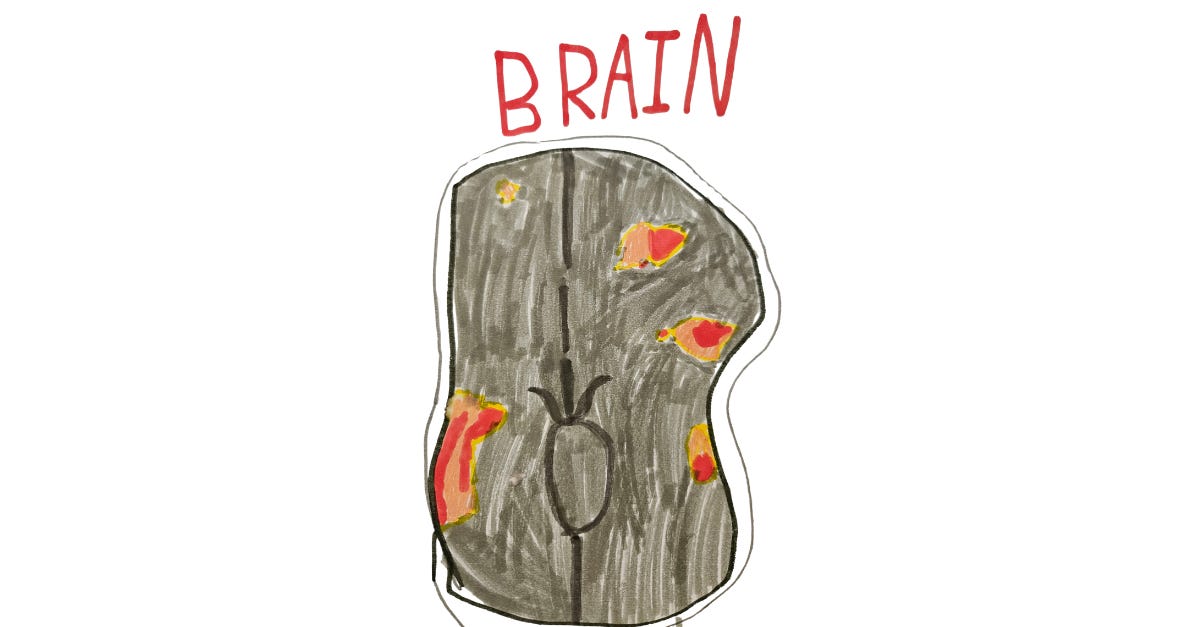
In a macro sense, we can get a broad picture of what a drug does to the brain through fMRI scans while the drug is on board. Basically, we look at what regions of the brain ‘light up’ with extra blood flow in response to certain stimuli. But these scans simply show activity, and the brain has both inhibitory and excitatory neurons, which means even when you see a beautiful rainbow of coloured patches on the screen, you don’t know if that activity is actually causing behavioural dampening! But let’s just put that slightly concerning piece of information aside for now and assume colour equals behavioural excitement.16
What we do know is that when obese people (with or without T2D) are shown food cues without GLP-1 on board, their brain’s reward systems light up like rainbows — far more than lean individuals. This heatmap is the visual representation of deafening ‘food noise.’ When the same test is run with GLP-1 on board, the brains of obese people suddenly become far less colourful at the sight of food.17
This tells us that injected GLP-1, which doesn’t cross the blood brain barrier remember, still has an almighty influence from behind that barricade. It truly does reduce the ‘food noise’ within a person whose volume was turned up far too loud (but not in one whose volume was at normal decibels).
But when tests are done at the micro level — when actual dopamine levels are measured within the striatum (in mice) — the results are far less clear cut. Some studies showed no change in dopamine spikes in response to food cues. Others showed the opposite of what you’d expect: rats on chronic semaglutide worked harder for food and ate more of it when freely available!18 And the most puzzling study of all — the WTF study above — showed that GLP-1 made dopamine increase at the moment of consumption. (Is the ground shaking beneath your feet a little too?)
Clearly, the rainbow does not translate to the spike. Which means there is a huge gap in our knowledge between the macro and the micro.
The third prong
This may be one of the more obvious statements I’ve ever made, but I highly value the ability to use my brain — to be able to learn, have insights, be curious and build new things. I don’t go overboard with crazy nootropics (with the exception of a little NMN or L-glutamine sprinkled here and there). And I’m very wary of taking anything that may compromise my ability to think. Which is why anecdotal reports of people saying GLP-1 made them lose some of their ‘will’ made the hair stand up on the back of my neck.
Loosely speaking, the dopamine system is the ‘will’ system, which we know is being impacted somehow by GLP-1, however indirectly. Dopamine also plays a crucial role in creativity — dopamine acting in the striatum supports divergent thinking while dopamine acting in the prefrontal cortex supports convergent thinking.19 Together, at optimal levels, that beautiful interplay yields creative output and insights. Which is why I would be very cautious in taking anything that manipulates that interplay, (however indirectly).
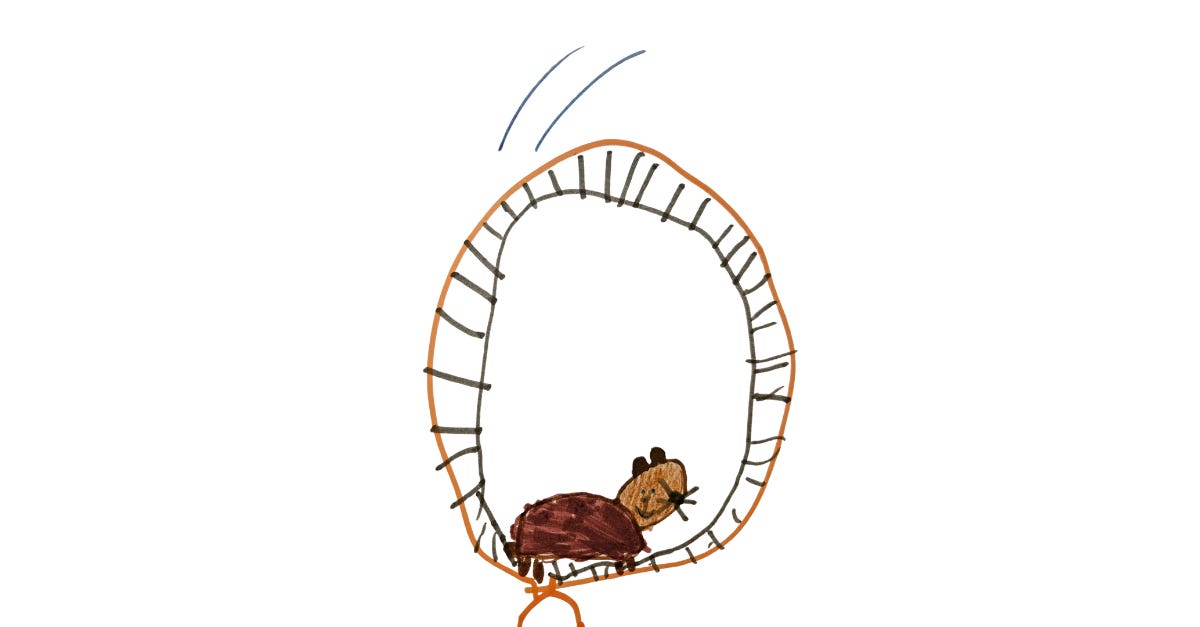
We’re nearing the frontier now. There are very few studies on motivation and GLP-1 out yet, and what little there are just raise more questions. The one that concerns me most is a study that looked at mice and their intrinsic love of wheel running. They voluntarily do it seemingly out of pure enjoyment — it is a beautiful example of a reward tied to effort (a holy grail many humans strive to reach).
With GLP-1s on board, the mice in this experiment… stopped loving running. They ate less and ran less, even after accounting for lower energy and day one nausea.20
They simply lost the will.
Now, this is just one study (and a preprint to boot), but when you couple that with the following kinds of comments from humans taking GLP-1, it paints a concerning picture.21 (To be clear, the following voices are the minority report. Most people on GLP-1s describe relief, not flatness, a kind of “peace” after the food noise stops. I’m foregrounding the darker reports precisely because they’re the ones the popular narrative leaves out.)
As a creative my work is suffering because I don’t feel the usual “rush” or sparks of energy to make quality work.
For me, not only was my creativity as an artist temporarily destroyed, but I also fell into a deep depression for many months that only lifted after stopping.
I miss all the inspiring sparks of creativity. […] I feel the whole party in my head left.
We’re designed to create rather than consume — to find meaning and reward within the process of growth itself, rather than just at the end. Dopamine isn’t just the heart of our will, it’s the soul of our creativity. It’s the very thing that drives us to follow our curiosity — to explore and build.
If you take away the spark that makes us human, what is left?
Building on quicksand
In the early 1980s, we were only just beginning to scratch at the surface of dopamine’s vast role in the brain. In fact, at first researchers thought dopamine was the pleasure molecule — a neurochemical that surged through the striatum when a reward was attained. In the decades that followed, this idea turned to quicksand under their feet when researchers realised dopamine wasn’t about pleasure at all. It was about prediction, and therefore pursuit.22
I can’t help but wonder if we are at a similar stage in our understanding of GLP-1 — caught in the morass and unable to find purchase, questioning even the solid foundation of our own dopamine understanding.
My research may have left me with far more questions than answers, but there is one question to which I at least have an answer:
“Would I, a metabolically healthy person, take (even microdoses) of a GLP-1?”
No, with what (little) we know right now, I would not. Because if I had been on GLP-1 while researching this very essay on GLP-1, would I have had the sustained curiosity, the dopamine-driven drive to chase down conflicting papers — the motivation to keep digging when the ground kept shifting? Would I have been able to build this network of understanding at all? The irony is not lost on me, and it only heightens my caution.
With my curiosity intact, I will continue to eagerly devour (terrible pun intended) any new research as it is released, looking for answers to help pull me out of the quicksand.
Having lived with deafening "food noise" for the better part of two decades of my life, I don't begrudge a single person for wanting to take a drug that stops it.
I ended my own food noise using dopamine programming, which is a more permanent behavioural change, but it does require forging through the discomfort of synaptic weakening.
For those for whom the drug is not an option, or who have had food noise return when you stopped, this protocol is now something I build with people personally, using the HIYB app. First, you develop awareness around your patterns, then I design a custom protocol to rewire your dopamine system so you're free of the compulsion to binge or overeat. The app helps you implement that protocol and shows your progress, so the rewiring becomes tangible — you see exactly how far you've come, and how far you've got to go.
References for this essay, and for the wider series, are available as a collection in the Research Library, specifically:
Incidentally, this is a dopamine-driven process that starts out with more negative prediction errors (dopamine dips at incorrect inferences) and then starts to yield more positive prediction errors (dopamine spikes at correct inferences) over time. It is a beautiful system for problem-solving that actually has immense relevance to the last section of this essay.
These are the researchers’ own words from the paper’s discussion. The study found that semaglutide increased dopamine during reward consumption, the opposite of the suppression they anticipated (Kooij et al. 2024). Merkel et al. (2025) further showed systemic GLP-1R agonists increase activity of VTA GABA interneurons (which inhibit DA neurons), providing a circuit-level mechanism consistent with phase-specific effects.
The drugs we call GLP-1s are actually GLP-1 receptor agonists, molecules designed to mimic our natural GLP-1 signal.
At the top dose tested (0.5 mg/week), semaglutide cut how much people drank on days they drank with a large effect size (Cohen d ≈ 0.87) and significantly reduced weekly craving with a small effect (d ≈ 0.31) (Hendershot et al. 2025).
Also just one of many comments like this on Reddit. Others reference a loss of interest in other “rewards”: “I have lost interest in sex as well when I’ve always had a high sex drive. […] I get off work and sit on the couch and I don’t get back up. When I am late with my injection, I actually feel happy and in a good mood.” Or joy itself: “It’s not that I don’t experience joy because I do. I just don’t care that much anymore.”
The first study to look at GLP-1’s effects on the brain’s reward circuitry (as opposed to the hypothalamic and brainstem circuits governing homeostatic hunger) showed that the GLP-1 agonist exendin-4 reduced the rewarding value of food via the mesolimbic dopamine pathway. It was published in 2012, roughly seven years after the first GLP-1 drug reached the market (Dickson et al. 2012).
Using fibre photometry of VTA dopamine neurons in mice, semaglutide left cue-phase dopamine unchanged but enhanced dopamine during the consummatory (reward-collection) phase, the opposite of the expected suppression (Kooij et al. 2024).
People quitting early pulled down the average. Reasons for quitting included cost, insurance barriers and gastrointestinal side effects. Second-generation GLP-1s (dual GLP-1 and GIP) produced better outcomes: 16–23% in trials and around 12% in the real world, with corresponding cardiometabolic benefits (Jastreboff et al. 2022). The cessation pattern held here too: after stopping tirzepatide, most regained at least 25% of their lost weight within a year, and over half regained at least 50% of it — with cardiometabolic gains reversing in step (Aronne et al. 2024, Horn et al. 2025). The semaglutide rebound figure above comes from the STEP 1 extension (Wilding et al. 2022).
They’re still trying to tease out how much of the cardiovascular benefits are due to the reduction in weight itself. Some studies point towards GLP-1s having an additional benefit, like anti-inflammation (Nature Biotechnology 2025). Others point away.
In real-world data (Epic Research, ~20,000 semaglutide patients), 17.7% regained all their lost weight or more within a year of stopping — but 56% either maintained their loss or kept losing. So complete regain is a minority outcome. Partial regain is more typical. This is notably less dramatic than the trial rebound (footnote 7), likely because real-world patients lose less to begin with and stop more gradually (Bartelt et al. 2024).
Untangling the drug’s direct effects from the effects of the weight loss it produces is a difficult problem. Some benefits (most notably anti-inflammatory ones) appear partly independent of weight loss in both animal and human studies, but for many outcomes the two remain difficult to separate, and studies with the controls needed to isolate them (e.g. weight-matched or pair-fed comparators) are still relatively few (Wong and Drucker 2025, Gonzalez-Rellan and Drucker 2025).
Retatrutide, the third-generation agent with an added glucagon arm, produces the largest heart-rate increase of the three, around 6.7 bpm on average at the top dose versus roughly 2–4 for the earlier drugs. This is likely driven by glucagon’s direct chronotropic effect (Jastreboff et al. 2023). (Reduced HRV is assumed to correlate, though the trials measured heart rate directly.)
Systemic GLP-1RAs selectively suppress palatable food intake via the central amygdala circuit without necessarily affecting standard chow (homeostatic feeding), a major finding (Godschall et al. 2026).
Even researchers aren’t immune to this folly. There are some literature reviews within papers investigating the impact of peripheral GLP-1 on the brain that cite studies on central GLP-1 acting on the brain (Kooij et al. 2024).
The BOLD signal that fMRI measures is only an indirect proxy for neural activity, and a coarse one at that. Because increased inhibitory activity can raise local metabolism just as excitatory activity does, a ‘lit-up’ region can’t be read cleanly as excitation: BOLD reflects a mixture of excitatory and inhibitory signalling, and the two can’t be separated from the map alone (Logothetis 2008).
In human fMRI studies, people with obesity (with or without type 2 diabetes) show heightened responses to food cues in reward- and appetite-related regions (insula, amygdala, putamen) compared with lean individuals. A GLP-1 agonist reduces this exaggerated cue reactivity. This effect was blocked by a GLP-1-receptor antagonist, confirming it's receptor-mediated. And the reduction appears in obese but not lean participants (van Bloemendaal et al. 2014, Eldor et al. 2016).
The chronically-treated-GLP-1 rats paid a higher effort price for food. And when there was free access to food, the GLP-1 rats ate more than control. This cuts directly against the behavioural effects we see in humans (Chang et al. 2026).
Dopaminergic modulation of fronto-striatal networks supports creative cognition: striatal dopamine facilitates cognitive flexibility (divergent thinking), while prefrontal dopamine supports persistence (convergent, focused thinking). Critically, the relationship is an inverted-U — moderate, not high or low, dopamine levels are optimal for each (Boot et al. 2017, Zabelina et al. 2016).
In this study, semaglutide reduced both voluntary wheel-running and the willingness to work for wheel access (measured by how many nose-pokes a mouse would perform for it) in lean and obese mice. Crucially, pair-fed controls (given the same reduced food, so matched for weight loss) also ran less, but the semaglutide mice ran less still, indicating a drug-specific effect on motivation beyond the effect of eating less. The suppression held after removing the first day (ruling out nausea). It is a preprint, not yet peer-reviewed (Foscue et al. 2025, preprint). Emerging human data on motivation, anhedonia, and cognitive effects are mixed but warrant caution (De Giorgi et al. 2025, Krupa 2025)
The reports of people who find themselves being able to think more clearly is I suspect due to the reduction in ‘food noise’ and other cue-related cognitive activity. When you take away these environmentally-triggered dopaminergic intrusions, the mind will of course feel clear by contrast. But there is absolutely no research on GLP-1 and its impact on creativity to date, so I took to Reddit and asked if anyone had reported impacts to their creativity or motivation while taking it. There is of course a selection bias here, but the fact that this anecdotal evidence even exists in the first place should not be readily dismissed.
The “dopamine = pleasure” idea originated in around 1980 (Wise). It was dismantled from two directions: Berridge’s work showing dopamine mediates ‘wanting’ (incentive salience) rather than ‘liking’ (hedonic pleasure), and Schultz’s discovery that dopamine neurons signal reward prediction error — firing to unexpected rewards and to reward-predicting cues, not to reward itself. Both successor accounts are about anticipation and pursuit rather than pleasure (Wise 1980, Berridge & Robinson 1998, Schultz et al. 1997).
I read this out of concern for friends on it - one friend has lost a ton of weight, but her skin is so saggy and even exercising it still looks weird and she's also depressed. Another friend has lost weight but seems ok emotionally.
I personally have suffered food noise my whole life and have recovered from eating disorders by doing things the healthy way - so i agree with you, it's a curious drug but Id be terrified to take it.
Magic Pill by Johan Hari is a great book on this