

Don't detox. Aim your dopamine.
Someone else has their finger on your trigger. Here’s how to take it back.

Dopamine has a reputation problem. It’s widely regarded as the “pleasure molecule,” a malevolent little chemical determined to keep us running on the hedonic treadmill.
That reputation has spawned slogans like “dopamine fast”1 and “dopamine detox,” and monk-esque practices like staring at a blank wall for minutes on end or “rawdogging” an international flight.
But it is here that I feel compelled to step in, don my Great Helm and hold up my medieval shield, because dopamine deserves to be defended! It is the neurochemical behind every great achievement any human being in the history of mankind has ever accomplished.
You don’t need to “fast” from dopamine (nor is it even possible). And you certainly don’t need a “dopamine detox.”
You need to be the one with the finger on its trigger.
What dopamine isn’t
First and foremost, dopamine is not pleasure. Sometimes it is released alongside pleasure-eliciting neurochemicals (endogenous opioids). And sometimes it is released alongside fear-eliciting neurochemicals (noradrenaline). And sometimes it surges through specific parts of your brain in relative isolation, the dominant neurochemical of that moment.
More than anything, dopamine is the learning molecule. It helps you learn absolutely anything and everything, from knowledge to skill to habits to addictions to memories.2 It is the fuel that turns consciously effortful things into subconsciously effortless things.
When Kasparov’s “final key moment came to me like lightning” or Gretzky “knew where a player was going to be” or Gauss “had the result before he had the proof,” they were standing upon the shoulders of giants built entirely in their subconscious, all using the power of this beautifully potent learning molecule.
I often refer to dopamine as magic because what it allows us to achieve belongs in the realms of the fantastical. But like any fairy tale that involves magic, it can be used for good or for evil. Someone unable to break out of an addiction would describe it as dark magic. The Gretzky’s of the world would describe it as white magic.
The valence of its power is all dependent upon who (or what) is triggering it.
What dopamine is
Dopamine does not discriminate. Wherever it is squirted in your brain is where the learning happens.
If it’s released in the motor pathway (dorsal striatum), you’re learning behaviour — automated action sequences like brushing your teeth. If it’s released in your motivation pathway (ventral striatum), you’re learning motivation — what path you will feel more compelled to take in future. And if it’s released in the thinking pathway (cortex), you’re learning more complex models, about yourself and the world around you.
The more models and actions you can assimilate under the influence of dopamine, the more your achievements will look like pure magic to others.
How it starts
Every pattern — model or action — that we carry out (or that spontaneously emerges) without conscious thought starts out with conscious effort.
Take playing an instrument, for example. While practising, dopamine slowly rises within the cortex as you hold the model of your own finger patterns and the musical notes they correspond to in mind. Within the motor pathway, dopamine actually drops every time you fumble the pattern as your brain rapidly learns what doesn’t work,3 until it gives way to what does, at which point there is a small spike. These motor spikes, bolstered by the elevated dopamine in the cortex during focused attention, slowly integrate the sequence and its patterns into memory until one day your fingers fly over the keys without thought.
Every new concept, fact, or piece of knowledge you learn also starts out with conscious effort. Again, dopamine rises in your cortex while you focus on the new knowledge, trying to work out how it fits into your existing models. Over time, as more associations are built, your cortex assimilates the knowledge and it can be retrieved and called upon without concentration — or spontaneously descend from the heavens like a bolt of lightning, telling you to sacrifice your rook.
What keeps it going
Whether you’re learning an instrument or a new subject, learning is hard.
You’re constantly butting your head up against false inferences or fumbling the shot or making those around you wince at the sounds emanating from your instrument. What keeps you coming back?
Motivation dopamine.
While learning may be hard, when you stick with it, there are moments where you get an answer right, or a lightbulb illuminates within your mind or the strings you just strummed reverberate around you in harmonious perfection. And with each of these moments comes a surge of motivation dopamine.
You surprised your brain!4
Your actions made the next moment in your timeline far better than it predicted. (Ye of little faith, dear brain?) Where there is a deviation between predicted reality and actual reality, there is a learning opportunity. And dopamine surges out like magic to capture it.
Motivation dopamine bolsters actual learning with the desire to keep learning. To do it again and again.
What makes it stall
As you become more proficient, the shoulders of giants in your subconscious stand a little taller and you start to get things right more often than not. Your new capabilities are now the higher benchmark against which the surprise is computed. If you don’t continue to up the ante on challenge, you’ll surprise your brain less frequently and therefore feel less frequent surges of motivation to keep going.
This is why it’s boring to become proficient. Your brain is built to be challenged — to be surprised, and to take what triggered that surprise, assimilate it, level up and move on to the next echelon of challenge.
Those who follow this path higher and higher are those whose own actions are triggering the surprise. They are triggering their dopamine from within.
The danger is when your dopamine is triggered from the outside.
The magical law
When you’re the one surprising your brain with your actions, you’re the one triggering your own motivation dopamine. But when you let the surprise come from your environment, you’re letting your environment trigger your motivation dopamine.
This isn’t always a bad thing, provided one rule — a magical law if you will — is obeyed: that you’re already triggering your own dopamine in the cortex.
Put simply, if you’re actively using your brain (and sometimes, your body) when the surprise is triggered, the motivation dopamine is adaptive. It’s tied to the actions that led to the surprise and makes you want to repeat them — to continue getting better.
But if you’re not using your brain when a surprise is triggered, that surge of motivation dopamine is tied to external cues. It’s not wiring in the desire to get better. It’s wiring in pure and unadulterated desire itself.5
Stolen motivation
Think of what happens when you doomscroll. You’re not actively searching for anything, but rather being passively fed a conveyor belt of micro-content. Without a goal in mind, there is no model to update or extend, nor skill to be improved. Any “surprise” comes purely from novelty, provocation and validation.
Social media platforms and news feeds prey on this fact, engineering content delivery to try and provoke any kind of emotion within you. Because where there is emotion, there is dopamine. Whether it be happiness, outrage, disgust or pure surprise, that feeling is an outside entity with its finger pulling the trigger on your motivation.
Every time you feel an emotion without a goal in mind, you’re not learning — you’re learning compulsion.
Which network are you building?
Every time you hold a goal in mind, you’re activating your own inner network of nodes (neurons) in unique configurations. These form the models related to your goal. When you’re actively learning and dopamine has risen in your cortex, you’re linking new nodes to those models — extending your own knowledge and capabilities. And when you surprise yourself, you feel motivated to add more.
But when you’re not holding any goal in mind — just scrolling — your dopamine is still building a network. Just not the one between your ears.
Instead of wiring more value into your own network of neurons, your neurons are being wired into someone else’s network — using your very own dopamine to do it.
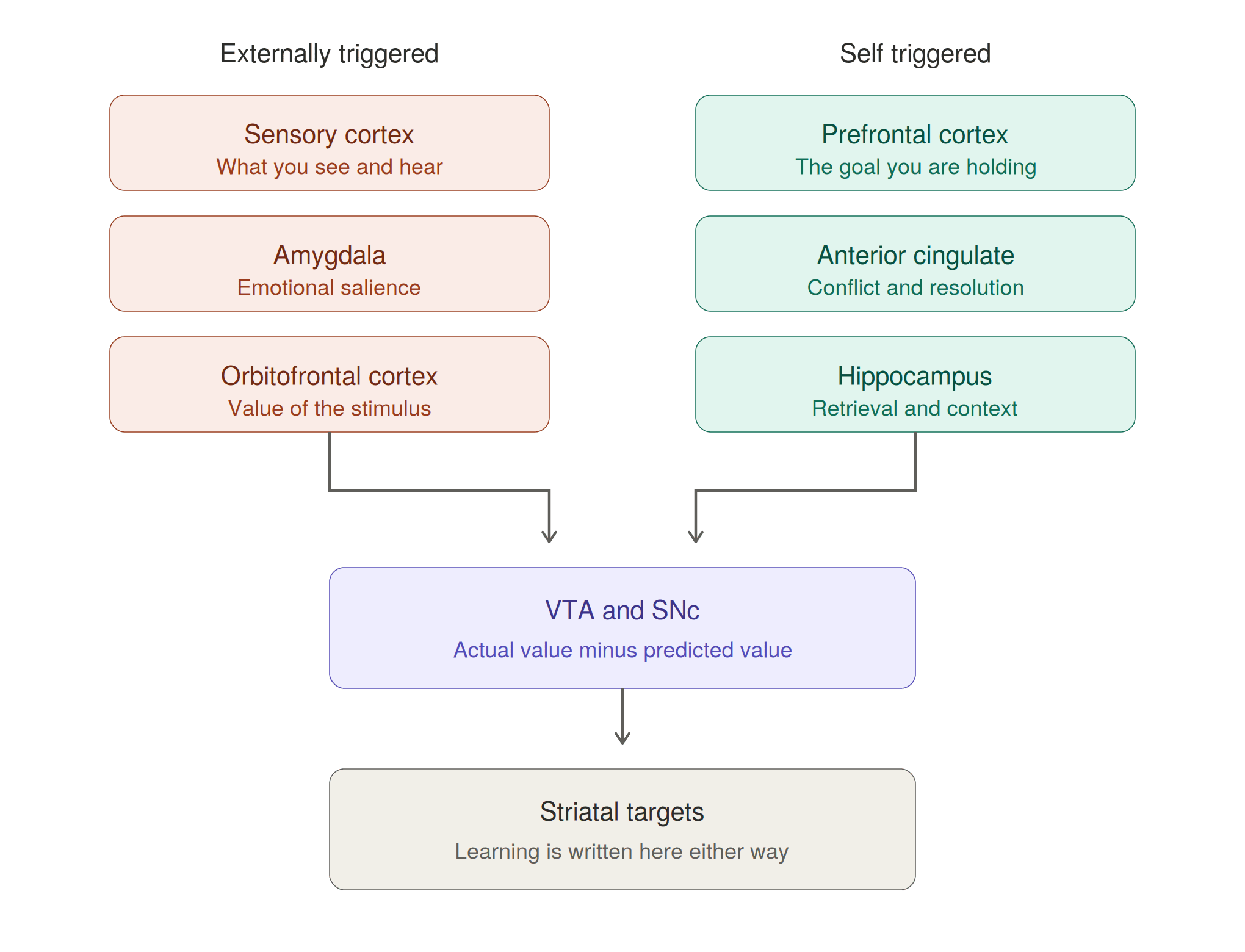
You only need to look at how the dopamine system calculates a “surprise” in order to see who has their finger on your trigger. When the surprise comes from the outside world, the inputs come from what you can sense (sensory cortex) and feel (amygdala).6 When the surprise comes from within, the inputs are taken from a sudden resolution of conflict in your cortex (prefrontal cortex and ACC).7
Wireless wireheading
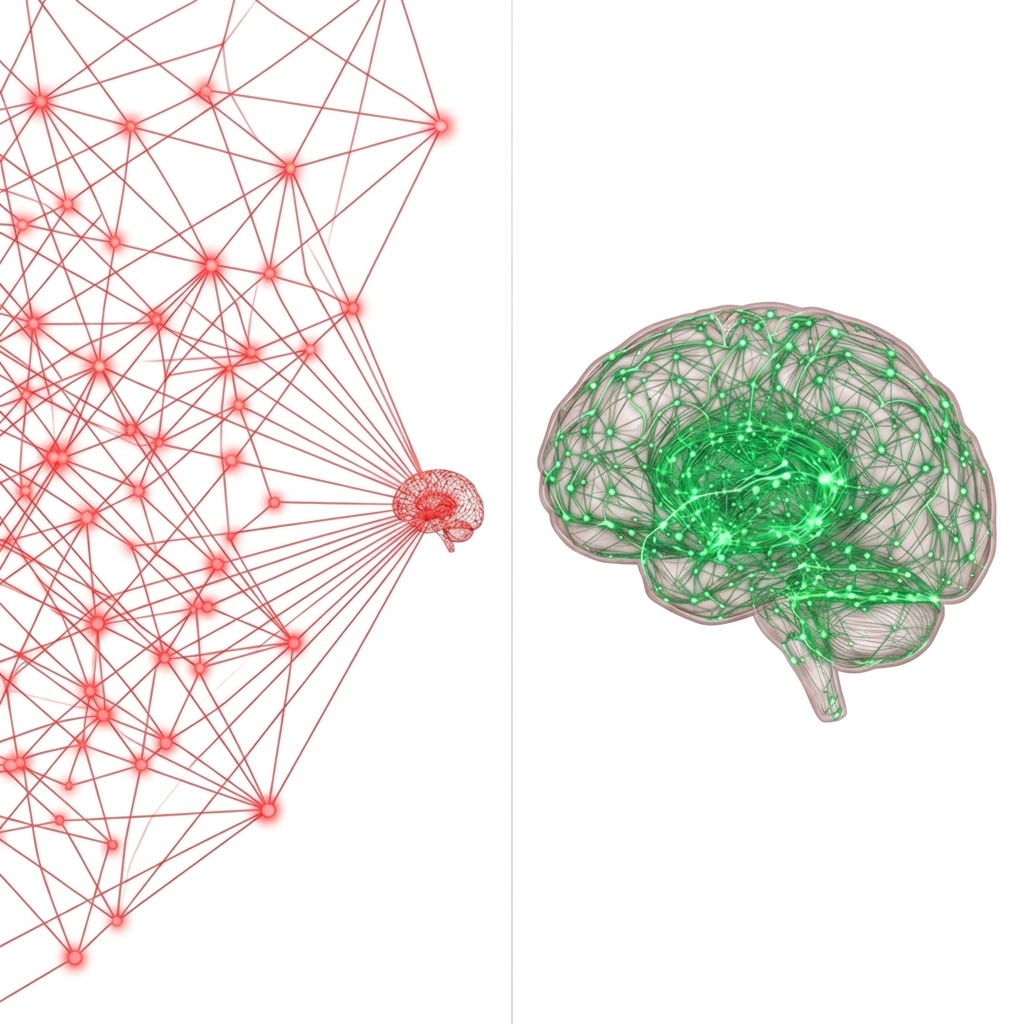
In a series of experiments beginning in the 1950s, researchers placed electrodes directly in the brains of rats.8 Whenever the rats pressed a lever, these electrodes buzzed, artificially triggering a surge of dopamine. There was no work to be done, no maze to run, no food to be earned — no goal to hold in mind. All the rats could do was press the lever.
And frantically press it they did, sometimes thousands of times an hour, to the exclusion of sleep, food and other basic needs. Eventually, these poor little rodents collapsed at the foot of the lever with sheer exhaustion.
Well, it’s now 2026 and we’ve gone wireless.
There is no need for electrodes. Every flick of your thumb is a press of the lever. In fact, in many ways, the rats and their lever were a more humane setup than the infinite scroll due to one inescapable fact: your feed keeps the “surprise” uncertain. You don’t know if the next flick will make you laugh, or make you feel giddy or make your blood boil. Or do nothing. This uncertainty tells the brain the next flick might be worth something — motivation dopamine surges even higher and your desire to keep scrolling increases.
Your finger on the trigger
Motivation dopamine is like pure energy. It propels you forward, makes you want to take certain actions, to follow certain paths. When you hand the trigger of that precious resource to the external world, you become a stimulus-response machine, ricocheting through life, feeling as if your will is not your own.
Motivation with purpose is passion.
Motivation without purpose is compulsion.
The next time you find yourself flicking through your feed, ask yourself, “What is my goal here?” If your answer is, “I’m just seeing what’s out there,” then The Platform has its finger on your trigger, not you. Dopamine fasts and detoxes may prise that finger off, but a trigger with no finger on it is a brain that has stopped learning.
So take it back. Don’t fast, don’t detox, don’t try to feel less. Instead, learn.
Aim your dopamine — point it at something you're actually trying to get better at, so the pull you feel is passion for building the network between your ears, not compulsion to build someone else's.
And while you’re at it, pick up a shield and join my inadvertent crusade in defending the good name of dopamine. Because if you retain any of the information in this essay, it will all be because of that beautiful little molecule.
Knowing the mechanism and rewiring against it are two different things. If you want to get your finger back on the trigger, I build custom dopamine engineering protocols delivered through the free HIYB app. You can use it to rewire any kind of maladaptive behaviour (or thought pattern), from food cravings to smoking to drinking to procrastination to compulsive phone use. The app tracks the weakening pathways as you go, which makes the invisible change in your brain visible.
References for this essay, and for the wider series, are available as a collection in the Research Library, specifically:
The term dopamine “fast” was coined by psychiatrist Cameron Sepah, whose original prescription was more nuanced than the practices it spawned. It emphasised awareness of the relationship between stimulus and response, which is much closer to the mark than staring at a wall.
When I refer to learning enhanced by dopamine, I am referring to the threshold for LTP being lowered when dopamine is elevated in certain regions of the brain. Even if the phasic modulation isn’t sufficient to trigger “instant” LTP, it reduces the number of repetitions that would otherwise be needed to hit that threshold. (Hebbian learning of course can occur without an increase in dopamine, but it is important to recognise that even here, dopamine is present at tonic levels. It always plays a role in learning, no matter the “type.”)
A negative RPE (outcome worse than predicted) produces a phasic dip below baseline dopamine. In the striatum this acts as a teaching signal that lowers the propensity to repeat the action that underperformed, the mirror image of the positive-surprise signal that reinforces success. The dip is largest when you expected to succeed and didn’t, which is why fumbles sting more once you’re more proficient.
The “surprise” here refers to reward prediction error (RPE), the computation that yields a dopamine spike, which is essentially actual value minus the predicted value.
Both self-triggered and externally-triggered dopamine share the same RPE computation machinery (VTA/SNc as the convergence node, striatal/habenular prediction channels), but differ mainly on the actual-value side. For externally triggered dopamine, the actual value comes from the sensory cortex and OFC/amygdala, while for internally triggered dopamine, the actual value comes from the PFC/ACC/hippocampus.
Sensory input is of course also used in inputs for self-triggered dopamine when there are physical motor sequences being learned, but the important difference is the activation of task-positive areas of the brain like PFC/ACC/hippocampus. These essentially mean the dopamine spike of surprise (RPE) is still “self-triggered.”
Conflict-resolution is the vivid case, but the shared ingredient is that the prediction is self-generated. Ordinary validated retrieval counts too: you reach for an answer, your own model predicted it was right, and the confirmation yields a positive prediction error. It’s a “self-triggered surprise” as long as the input is your own working model being validated, either by a sudden convergence of activity (i.e. insight) or an externally validated “Yes, that was it.”
Rats given the choice between electrical self-stimulation and food will press for the stimulation in preference to eating, even when food-deprived (Routtenberg & Lindy, 1965). The reinforcing sites cluster along the dopamine-carrying fibres of the medial forebrain bundle, which is why it's read as a dopamine effect.
This is such an interesting concept.
So theoretically in my conquest for sobriety I can take aim and train my brain to get my ‘dopamine fix’ from other sources?
Really enjoyed this one.
Quite apart from the faux science phrasing in dopamine fasting, what is the point of a "cleanse" that we will only later reverse? Much better to learn to aim your dopamine, as you brilliantly say. We need to create a lifestyle that works for us all the time. I'm sceptical personally that periodic holidays can help - beyond revealing the scale of the problem.