

Why criticism stings so much — and what it does to your brain
How to prevent criticism and negative comments from rewiring your nervous system for hypervigilance

Six days after I started my Substack journey, tentatively sprinkling comments throughout Notes, I got my first negative comment.
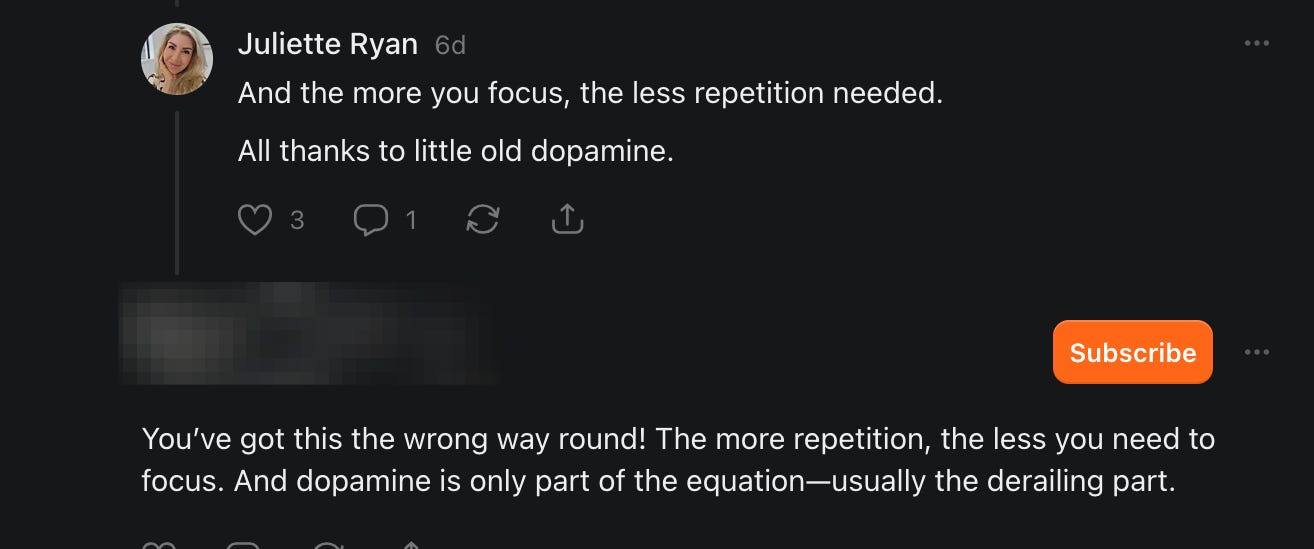
A fire-red poker thrust straight into my chest. I felt attacked — my very identity called into question. Part fight, part flight.
If logic had still been accessible, I would have thought: "Ah, I see what's happening here. I am describing the focused repetition that establishes a habit. He is describing the automated repetition of one already established. His 'dopamine is the derailing part' line is the standard misconception about a neurochemical that actually accelerates learning."
But logic had left the building (cranium?).
To my (presently melodramatic) mind, if I left his comment dangling there unchallenged in the thread, it was like a billboard advertising my incompetence was left hanging on the internet. Everything within me screamed to jump back in, keys blazing, and yank it down. Yet at the same time, I wanted to retreat, to withdraw into the comforting darkness of obscurity once more.
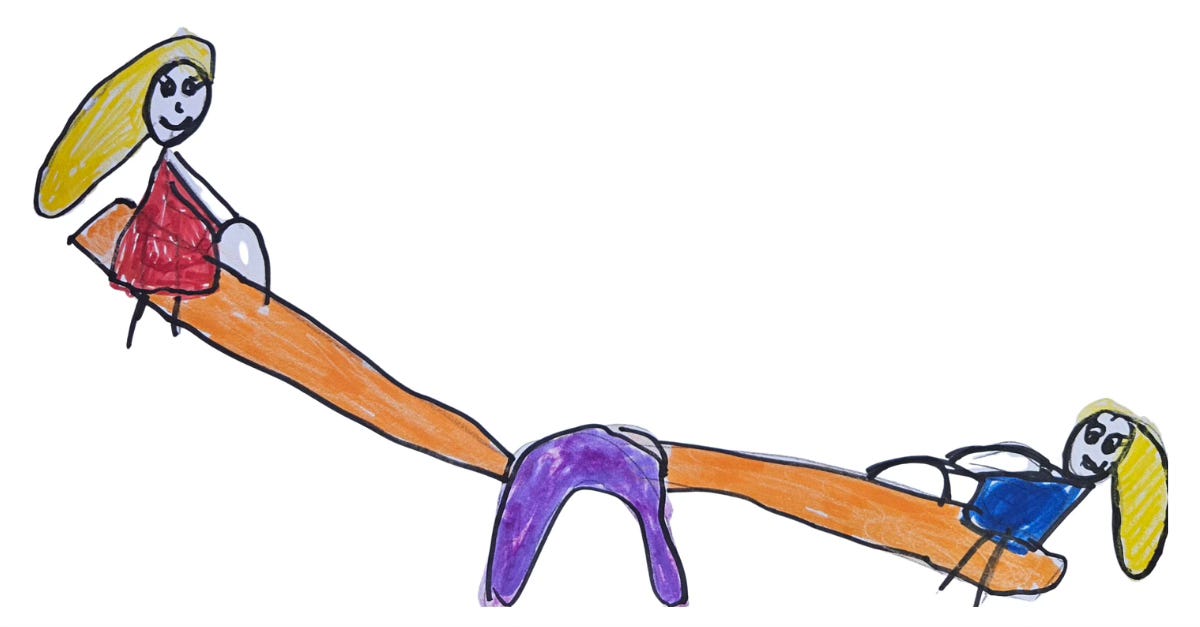
I know this sounds ridiculously hyperbolic, but to my brain, in that moment, I was being attacked. The usually balanced seesaw of my nervous system had swung dramatically to fight-or-flight.
Why does criticism — even from a complete stranger on the vast internet — matter so much to us?
What criticism does to your brain
Motivation
Any time we expose ourselves to social evaluation, there is hope — hope for approval, praise or validation.
Hope is uncertainty with positive valence. (Fear is uncertainty with negative.) And uncertainty is one of the most potent amplifiers of dopamine spikes in existence.1 Opening comments, checking messages, reading emails, waiting for feedback — all of these place the brain into a state of anticipatory uncertainty.
Which means we don’t receive social evaluation in a calm neurochemical state. Our dopamine system has bathed our limbic system in a surge of hopeful anticipation. And what goes up, must come down.
If we come across a negative comment, that initial hope is dashed and the anticipatory spike of dopamine is answered with a dopamine dip. In terms of emotion, this dip can feel like disappointment or frustration. And at a neural level, this dip wires in less motivation for the task at hand.
The very sight of your laptop — perhaps once a source of invigoration or excitement — may start to elicit feelings of aversion. (This is often the birthplace of the habit of procrastination.)
And this is the first thing criticism steals from you: your motivation.
Stability
Dopamine doesn’t just dip for dashed hopes. It can spike for strongly negative outcomes as well, a category to which social criticism firmly belongs.2 These aversive spikes actively wire in approach behaviour.
Approach behaviour, overlying a threat response, has a very specific name.
We call it anger.3
This fire-red poker drives the compulsion to correct the injustice — a volatile new layer over the disappointment and aversion the dip has already triggered.
And every time you imagine your reply, every time you mentally compose the comeback, you rehearse the approach. You reinforce the anger. The next negative comment will pull harder and you’ll meet it with more fire.4
Yet that original spark of hope never fades (such is the power of uncertainty). This is why you can find yourself feeling a confusing mixture of anticipation and dread when you go to read comments or check your inbox.
This is the second thing criticism steals from you: your stability.
Focus
We know that dopamine dips when an anticipated reward isn’t delivered. A chocolate bar yanked out of your hands the moment you go to take a bite would piss you off, undoubtedly. But it doesn’t threaten your survival. Social rejection very much does, at a fundamentally biological level.
Which is why criticism doesn’t just trigger dopamine dips and aversive spikes. Once the brain interprets the event as a genuine social threat, another neurochemical simultaneously surges into action: noradrenaline.
This sets off an immediate chemical cascade of adrenaline in the body and pulls the trigger on the slow release of cortisol (though this delightful hormone won’t hit its peak for another 20-40 minutes5).
This is the classic fight-or-flight state — a body and brain coiled, primed to grapple with a lion or scale a tree to escape a predator… all while often sitting in air-conditioned comfort on the soft cushion of your office chair.
You might even still feel focused, but when noradrenaline levels soar past the optimum, that focus becomes rigid yet fragmented. Your prefrontal cortex effectively goes offline, and the limbic systems it normally regulates run unchecked. You're fixated on the threat and unable to think of anything else.6
This is the third thing criticism steals from you: your focus.
Time
When we sleep, the brain’s memory centre (hippocampus) plays a kind of highlight reel of the day, based on what was most emotionally significant. These memories ripple out into the brain, strengthening any circuits they wash across.
A variation of this replay happens while we’re awake, whenever our brain is given a chance to wander.7 Any emotionally salient event that has recently occurred — such as someone calling into question your expertise on an internet billboard — will be replayed in an attempt to integrate that event in memory. It is the brain’s way of asking: “Is the threat over? Should the response be escalated in future?”
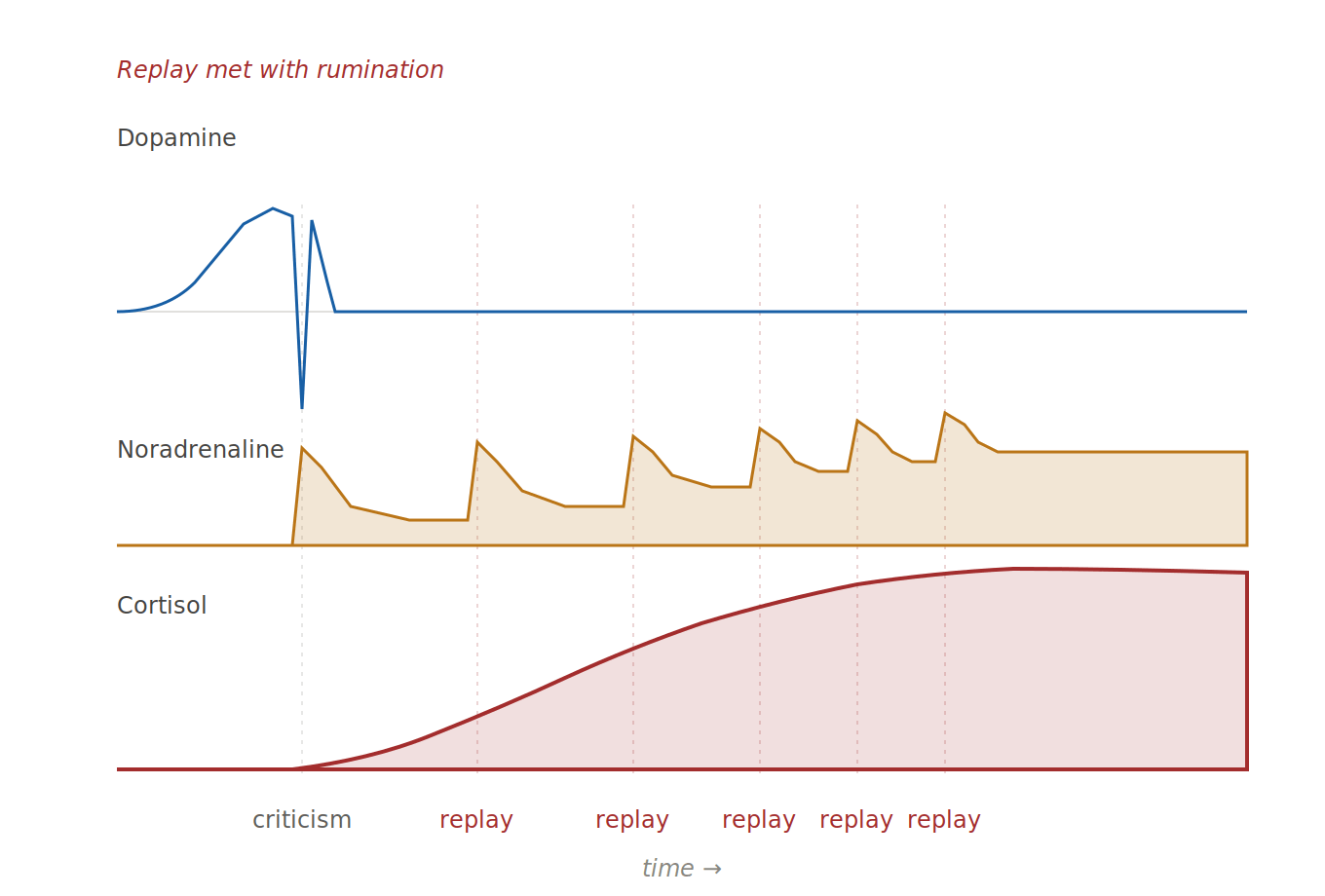
If we respond to one of these replays by re-entering the memory — by simulating alternative timelines, predicting future rejections, constantly re-evaluating ourselves — it is almost as if we have manifested the event all over again. Like reopening a wound, this immersion can trigger another massive autonomic response.
These replays aren't a fixed recording. Every time one surfaces, it is briefly available for editing — for better or worse. Whatever is present during the recall gets written into the trace. If you're in a reactivated threat state when the memory replays, that state gets re-encoded with it, and the memory builds charge.
When replay is answered with rumination (and therefore reactivation) like this, noradrenaline stays elevated (even outside the range of adaptive focus) and cortisol continues its insidious climb, making the inevitable peak even larger and more prolonged.
This is the fourth thing criticism steals from you: your time.
Resilience
Resilience is the seesaw's ability to quickly return to balance. Yet too many unintegrated social criticisms can leave the seesaw permanently tilted, each one steepening the angle. Eventually, the default state becomes one of low-grade vigilance, a nervous system on constant alert, waiting for the next threat.
When in this hyper-sensitive state, any comment (no matter how benign) is inspected, dissected and analysed by the brain, probing it for a hint of a threat. And if that hint is detected, the response is disproportionately large, triggering that turbulent sequence of anger, rumination and attentional rigidity.
Creativity requires an open mind and flexible nervous system. Or put simply, creativity requires an assumption of safety. A brain learning to be constantly vigilant is a brain losing its capacity for creativity.
This is the fifth thing criticism steals from you: your resilience.
How to prevent the theft
Unfortunately, very little of the initial threat response is controllable — it happens largely upstream of conscious control. We don’t get a say in this instant neurochemical cocktail of dips and spikes and cortisol ascent. But we do get a say in whether the response spirals into prolonged hypervigilance.
As soon as the threat is registered, we have a brief window in which to show the brain that further escalation is not warranted. The only language the brain understands at this point is hard evidence: physical signals of safety.
We need to talk to our brain through the body.
Breathing is one of the only automatic systems that can also be voluntarily controlled. We can use this to send our brain signals of safety, to quite literally tilt the seesaw of our autonomic nervous system back towards a parasympathetic state.
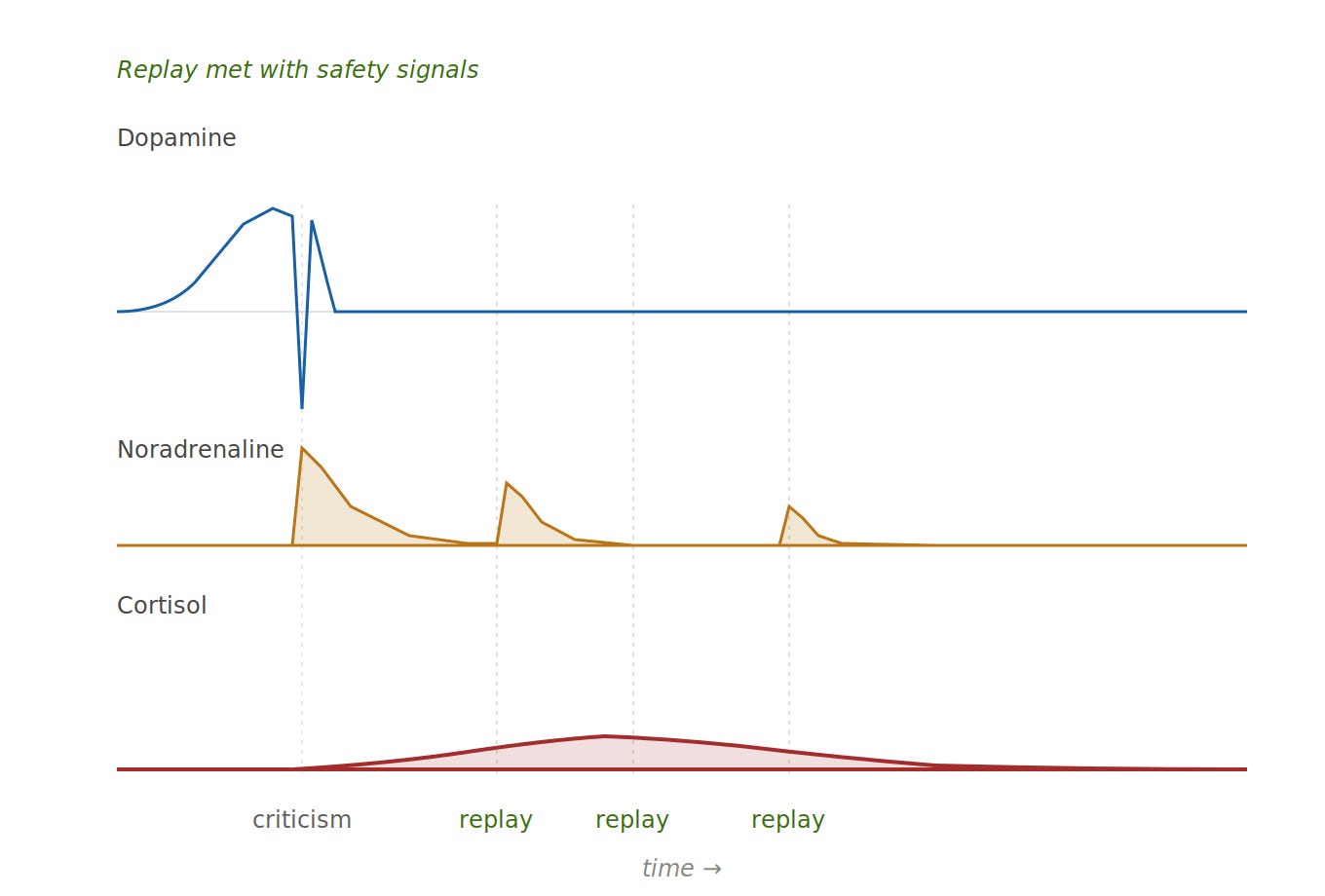
Once the body is in a state of safety, we are armed for the subsequent resurfacing. Every time the memory resurfaces, we can acknowledge it briefly — “Yes, that happened.” or “I don’t need to act on this.” — and then redirect attention away from it.
This is the opposite of suppression, which strengthens the memory by keeping it in threat-state without resolution. And the opposite of rumination, which rehearses the threat-state response and reinforces the anger. We simply register the resurfacing, hold the state of safety, and shift attention elsewhere.8
Because these strategies avoid re-entering the memory, and occur on a nervous system that is no longer on high alert, amplification is prevented. (While nothing can put the cortisol genie back in the bottle, if each resurfacing is met with a calm nervous system, its peak can be drastically reduced.)
A thing that happened
A few weeks after that first negative comment, I got another one. (It wasn’t the second, nor will it be the last.) This time, I was armed with the neuroscience.9
This comment was quite colourful, so I won’t relay its exact content here, but it still blatantly called into question my identity as a neuroscience engineer.
I viewed the comment at 7:15am. The threat response was triggered as expected. A sharp constriction of my chest, heat in my veins. That feeling of coiled mobilisation.
My brain was yelling (though not at its usual decibel), “Threat!” So I gently calmed it in the only language it would understand. I did three physiological sighs — two sips of air in, one big deep breath out. As the air wooshed out of my mouth, I could feel the seesaw slowly tilt back toward centre. Once upon a time, I would have been teetering precariously at the end of it.
This time, I was the calm, centred fulcrum in the middle.
With safety signals sent, I examined the comment. Was there anything I could learn from it? Did it warrant a reply? (Its colourful contents suggested: no.) Then I prepared myself for what would happen next: the resurfacing. Over the next hour, I knew my brain would continue prodding me with an echo of the event as it tried to integrate it in memory.
Ten minutes post-comment… While I braided my daughter’s hair, my brain foisted the comment upon my psyche three times, like an annoying push notification that has far overstayed its welcome. I acknowledged each one and redirected my attention to the present moment — the feel of my daughter’s hair between my fingers, the sound of my husband tinkering in the kitchen.
Twenty minutes post-comment… While I showered, the comment resurfaced twice, each time with less emotional charge than earlier. I whimsically imagined the words washing down the drain with the rest of the water.
Fifty minutes post-comment… While driving my daughter to school, the comment hazily materialised within my mind just once, with all the power of a wisp of smoke.
By 9:30am, when I sat down to work, it had disappeared from my mind altogether. In fact, when I went to write up this section of the essay, I had to go back into my notebook to remember the incident at all.
How I handled these little prods made the difference between whether the event became a perpetual threat that required constant vigilance, or whether it became simply a thing that happened, tucked neatly into memory between “braiding my daughter’s hair” and “morning shower.”
And then forgotten altogether.
Since then, even the involuntary sting of a negative comment has started to fade as my brain has learned that criticism does not require mobilisation — that anger is no longer necessary.
Motivation, stability, focus, time and resilience are the foundation of a fulfilling life. Don’t let criticism — or that one negative comment from a stranger on the internet — steal them from you.
Armed with this knowledge, you can become the fulcrum, too.
How do you feel when you come across a negative comment or receive criticism of your work? (Any fire red pokers?)
References for this essay, and for the wider series, are available as a collection in the Research Library, specifically:
Midbrain dopamine neurons fire most strongly when the probability of a reward is around 50% (the point of maximum uncertainty). Uncertainty is, in a very literal neural sense, what the dopamine system is built to track (Fiorillo et al. 2003).
The "dopamine = reward" messaging is one of the most damaging (in my opinion) oversimplifications in popular neuroscience. There are actually distinct dopamine populations, some that dip to aversive events (the classic RPE neurons), and others that spike to them. The latter are part of what makes negative events feel mobilising rather than withdrawing (Matsumoto & Hikosaka 2009).
Work on frontal cortical asymmetry has shown that anger is more of an approach-motivated emotion (as opposed to a withdrawal emotion like fear or sadness). Anger consistently shows the same left-frontal activation pattern as appetitive, approach-driven states, not the right-frontal pattern of withdrawal emotions (Carver and Harmon-Jones 2009). Neurochemically, it's "wanting," just like any other craving. That's why it feels mobilising rather than shrinking.
We've all heard the idea of venting to "get all the anger out." But surprisingly (even alarmingly), research says the opposite. People who vented after being provoked became more aggressive, not less, despite saying the venting felt satisfying in the moment (Bushman 2002). The "wanting" (anger) circuit gets stronger every time it fires, regardless of whether the firing happens out loud, in writing, or just in your head.
The timing varies by individual and stressor intensity and can extend beyond this range. Note also that adrenaline, released from the adrenal medulla via the sympathetic nervous system, does spike rapidly alongside noradrenaline — it is cortisol specifically, produced via the slower HPA axis (hypothalamus → CRF → pituitary → ACTH → adrenal cortex), that takes this longer route to peak.
At moderate NA levels, the prefrontal cortex (especially dorsolateral PFC) functions well. At high NA levels, NA starts activating alpha-1 and beta receptors, which impair PFC function. Dendritic spines in PFC neurons actually retract within minutes of high stress signalling (a fact I’ve always found amazing). The PFC effectively goes offline while the amygdala, which was being inhibited by tonic PFC input, is now disinhibited and its outputs run unmodulated.
Awake hippocampal replay is less commonly known than its sleep counterpart, but studies have shown that the brain replays recent experience during quiet wakefulness — often in reverse — as part of memory consolidation and retrieval (Foster & Wilson 2006, Carr et al. 2011).
This idea of memory reconsolidation is one of the most important findings in memory research of the last 25 years. Retrieving a memory briefly destabilises it, requiring fresh protein synthesis to "re-store." Whatever conditions are present during retrieval (calmness or anger) get added to the memory trace. This is why rumination is so corrosive. But on a positive note, it is also the mechanism that makes the procedure in this essay actually work (Nader et al. 2000).
I do want to say though, that negative comments are reassuringly few and far between, especially on Substack, but they do happen from time to time. It is an inevitability of putting yourself out there in some way on the global public forum that is the Internet.
This is so timely and helpful. This morning I shared with my business partner how a client’s repeatedly negative feedback on certain work products (when they chose not to show up for design reviews before we finalized the work) left me angry, frustrated and demotivated, with a good dose of resentment. Now I know why and have an alternative to loosing my sh**. Thank you
Thank you for this! It is very helpful!!