

Your brain is changing right now
What neuroplasticity actually is — and why it's happening this very second

I recently ran a little neuroplasticity experiment on myself. I wanted to see how well I could learn to play the guitar with only ten minutes of practice a day.
On day one, I learned what frets were and clumsily fat-fingered my way through a low E. Cats would have cringed if they could hear the sounds emanating from my husband’s guitar. (In fact, our two Shoodles probably did. They were conspicuously absent around this period.)
But by day six, I could play five chords. Not great, but passably well. Enough that our two Shoodles decided to stick around, at least.
By day nine, I could play some actual songs. (The easy versions, of course.) Weezer’s Island in the Sun. Boulevard of Broken Dreams. My rate of learning accelerated here, for a few reasons that we’ll soon dive into.
Two weeks in, I could play all nine cowboy chords and had nailed some basic strumming patterns. (I still think bar chords are the devil.)
I am no guitar aficionado, nor am I a savant, but I do possess a human brain that is remarkably capable of adapting to its environment — to what I direct my attention to.
Otherwise known as neuroplasticity.
The goal of neuroplasticity
Anything that suddenly appears in your mind or body — memories, emotions, thoughts, urges, habits, even the letters of the alphabet — got there through neuroplasticity.
Neuroplasticity is the reason that you can do or feel anything without conscious thought.1
How many hours are there in a day?
Where were you for your first kiss?
What is the sound of your best friend’s laugh?
As I asked these questions, I bypassed your prefrontal control and pulled answers and feelings straight into your awareness without thought. This is because at some point in the past, your brain deemed these things worth storing — and now they can be retrieved from your subconscious at lightning speed.
They are now a part of what makes you, you.
“It’s like riding a bike.” Any skill or knowledge, once mastered, is never forgotten and comes back to you the moment you need it.
Thank you, neuroplasticity.
Neuroplasticity is always happening
Believe it or not, at this very moment, neuroplasticity is happening within your brain. While your attention is focused on these words, connections between neurons within your brain are being tentatively strengthened.
Isn’t that amazing, and a little mind-bending? That your ability to comprehend these words is evidence that neuroplasticity occurred in the past and that neuroplasticity is occurring right now, in the present?
Neuroplasticity isn’t some mythical alternate plane of existence that requires a complicated key to access. And it certainly isn’t a power that adults no longer have access to. It is the ability to learn. Which means it is occurring within our brain every second that we focus our attention on something.2
The only catch is this — early-stage neuroplasticity is tentative and fragile. Something special needs to happen to lock in these changes.
What is a strengthened connection?
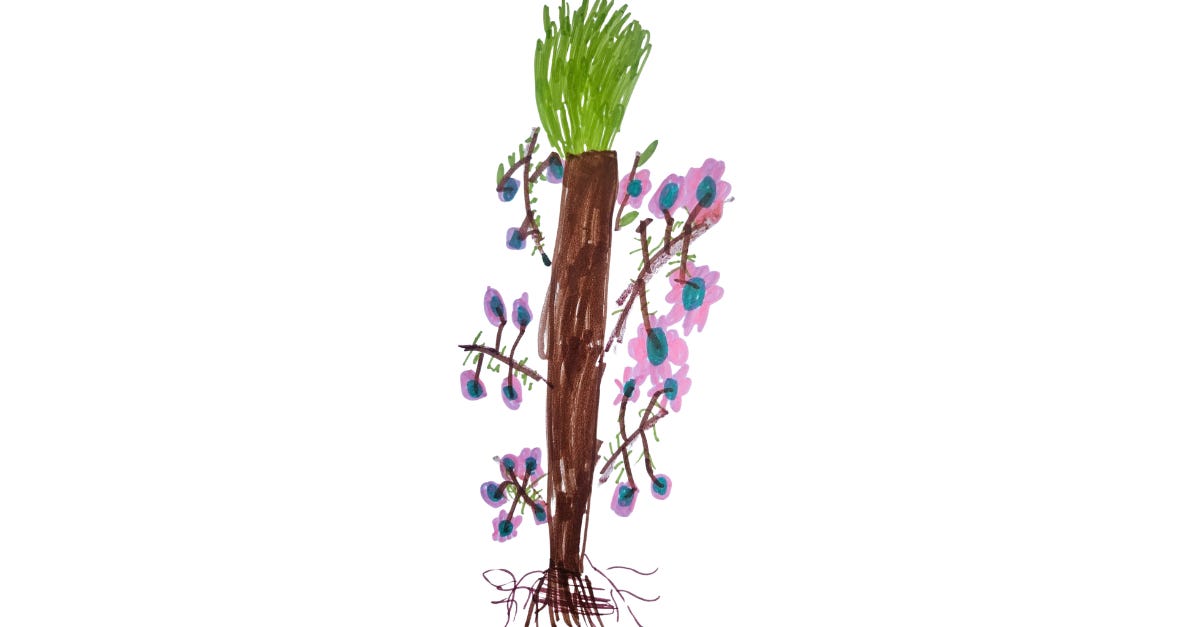
A neuron — a brain cell — looks like a beautiful tree with all these wonderful branches growing out the top, and an even more intricate root system growing out the bottom.
The root system is the receiving end (dendrite) of the neuron and the branches are the sending end (axon). Axon tree branches from neurons interweave with the dendritic roots of other neurons in an elaborate yet emergently precise communication network.
And all along each branch of a receiving dendrite are tiny little satellite dishes called spines.
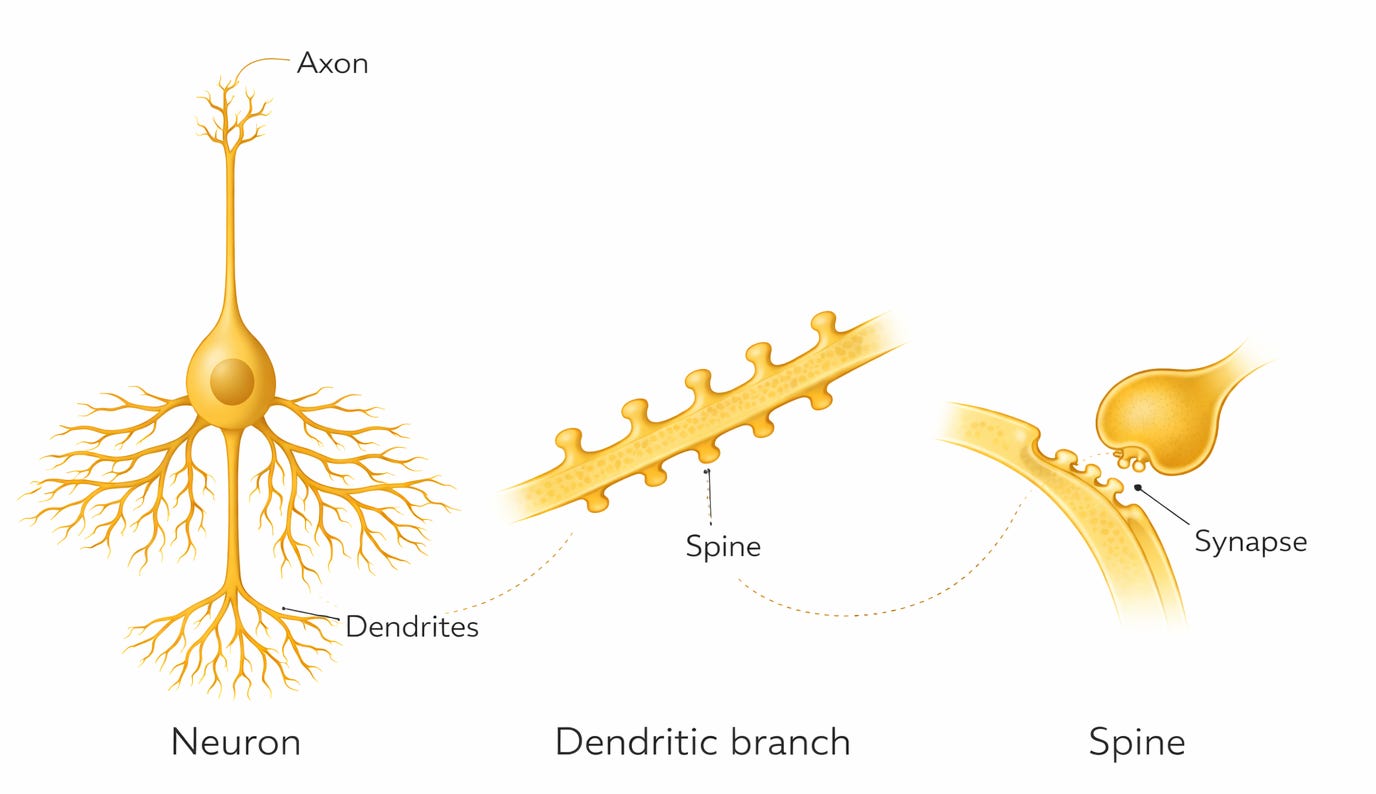
These little satellites are how the dendrite roots of a neuron receive signals from the tree branches of neighbouring neurons. These incoming signals are then analysed and transmitted through the cell trunk (soma) and up out its own axon branches, ready to be received by satellite dishes on other nearby dendrite roots.
The funny thing is, there is no physical connection between neurons. Those little satellite spines catch chemical signals across a tiny 20 nanometre gap (synapse). It’s a conversation across empty space.
So when everyone says that neuroplasticity “strengthens connections,” what do they actually mean? You can’t strengthen a gap!
The key is the satellites. These little guys are where neuroplasticity begins.
How neuroplasticity starts
When there are a lot of incoming signals at a satellite, it starts to chemically “warm up.”3 As it gets warmer, it quite literally grows larger, making it more sensitive to incoming signals, and therefore able to transmit signals faster.
Right now, with your attention focused on these words, certain circuits of neurons that contain your existing knowledge of the human brain (and knowledge of objects like trees and satellites, for that matter) are talking to each other across all those tiny gaps. And the satellites sitting on dendrites across from those gaps are growing larger this very second.
How magical is that?
How neuroplasticity becomes permanent
When it comes to anything magical, there is always a time limit. And neuroplasticity is no different.
These early physical changes — your little satellites expanding — only last for a couple of hours (at most) before the changes are reversed.4
This is by design. It would not be very helpful if everything we devoted our attention to became permanently automated within our brain.5 But things that we give our attention to repeatedly? Those the brain deems worthy of automating — of remembering. After all, the brain is nothing if not efficient.
Repetition
Every time you reactivate patterns of neurons (even by taking a few seconds to briefly remember earlier memories or learnings), those shrinking satellite dishes grow larger again, and buy you more time.
Because what all of these changes really need in order to become permanent awaits on the other side of your pillow.
There is a special genetic switch that needs to flip inside a neuron in order for those satellite dishes to stay permanently big.6 When this switch flips, little nanobots (proteins) are sent out to the enlarged satellite dishes to structurally secure them in their newly expanded state. Then these nanobots travel backwards across the gap to the sending branch and renovate it so that it becomes bigger and more permanent as well.7
Sleep to strengthen
One of the most crucial ingredients to flipping this genetic switch is sleep.
During the vital deep sleep we get at the start of the night, our brain blinks on and off every second, like morse code.8 When in an on state, the memory centre of the brain (hippocampus) sends out ripples in different directions, randomly reactivating patterns that were active earlier in the day.9
Any still-enlarged satellites are more sensitive to these ripples and light up with activity if one flows over them, allowing them to grow larger still. It’s as if your brain has stored a little recording of your entire day and is replaying it while you sleep, giving you free repetitions of what you learned earlier that day. (For better or worse.)
But when the brain goes dark the second after, the reverse occurs, and all satellites not structurally reinforced shrink back down a little. Across the entire brain.
It becomes a race. Can patterns containing enlarged satellites win the ripple lottery enough times so that they don’t lose all progress from the day?
When you wake the next day, the memories and knowledge you carry from the day before are direct evidence of patterns that won the lottery while you slept.
The shortcut to permanence
There is one other way to make a strengthened connection more permanent — to accelerate flipping that genetic switch for structural reinforcement.
This is where the brain’s chemical exclamation marks — dopamine and noradrenaline — come into play .10
When we are focused on something and experience a spike of arousal (good or bad), or a spike of anticipation or pleasure, these neuromodulators rapidly accelerate the growth of all those satellite dishes and ensure they stay larger for longer.11 (In some cases, they can even be powerful enough to flip the genetic switch for permanence right there, in that moment. No sleep necessary.12)
This is how a traumatic memory can become stamped into your brain in one shot — through a hefty dose of plasticity accelerant, courtesy of noradrenaline.
And it’s why positive feedback and encouragement during learning is so vital. All those little spikes of reward dopamine serve to further solidify the learning itself (as well as the motivation to keep learning in future).
Every time I nailed a new chord, or when my husband said my guitar was really coming along, or when my daughters cheered me on (or when our dogs didn’t slink away), all those beautiful spikes of dopamine helped amplify the plasticity effects of my focused attention.
While these chemical exclamation marks don’t always flip the switch in one go, they do jump start the process and rig the sleep replay lottery towards certain patterns.
This means that every night I got a good chunk of deep sleep (a feat in itself with two young children), I flipped the genetic switch on some of those guitar-playing circuits, automating some of the skill itself.
Metaplasticity
One of the lesser known yet arguably more fantastical aspects of neuroplasticity is that the synapses strengthened during neuroplasticity don’t just store what you’ve learned — they make it easier to trigger neuroplasticity on them again.
Enlarged satellite dishes allow the spine to warm up even faster, which in turn makes the satellite dishes grow ever larger, which in turn makes them warm up even faster! It is a beautiful positive feedback cycle of signal amplification that pushes the system ever closer to that genetic switch.
Every day I practiced the guitar, I made the next day’s practice physically easier at the synaptic level. I wasn’t just getting better at the guitar — I was getting better at getting better at the guitar.
But of course, there is a dark side to this metaplasticity.
The human brain is a miraculous and powerful learning machine, but its power can only strengthen what we point our attention to. If we feed it empty and meaningless rewards, it will learn to seek those rewards more efficiently and with stronger motivation, narrowing focus until all we see is the reward. If we feed it anxious thoughts and rumination, it will learn to imagine more and more future catastrophes, narrowing focus until all we see are threats.
An addicted brain and an anxious brain are evidence of a brain spectacular at learning — it has just been pointed at the wrong thing.
But if we feed our brain new knowledge, skill and experience, we don’t just learn to be more capable, we become more capable of learning.13
Your turn
Here’s a fun little exercise. Some of your little satellite dishes are temporarily enlarged right now, thinking about the very analogy of satellite dishes as spines on dendrites on neurons. If you take a few seconds to recall this analogy just a couple of times throughout the rest of the day (and ideally right before bed), your nightly ripples might just catch these patterns and make them permanent.
When you wake, see if you can remember the analogy. If you can, congratulations — you will have used neuroplasticity to etch in an understanding of neuroplasticity.
Just like I slowly etched in the skill of playing the guitar.
I may have barely scratched the surface of what one can actually do with the instrument, but if I’m ever sitting around a campfire and someone passes me a guitar, I’ll be able to strum a tune. The skill is there in my brain now, from just ten minutes a day.
Imagine what you can do with a bit of attention and ten minutes.
I'm planning on running another 10 minute neuroplasticity challenge soon — if you'd like to join, let me know in the comments. Let's see what we can achieve with just ten minutes of attention a day.
If you want to read more about the dopamine spike and the opportunity it gives you to rewire your brain, you might want to check this one out:
From addiction to agency: taking advantage of dopamine’s plasticity window

I’ve wrestled with how to begin this final essay in the series — my usual anecdotes felt too light for the raw weight of compulsive cravings. Then I unearthed a journal entry from five years ago, written long before I dove into neuroscience. Reading it now, I was struck by how closely it foreshadowed what I would only later come to understand.
References for this essay, and for the wider series, are available as a collection in the Research Library, specifically:
Neuroplasticity can also most assuredly occur in the prefrontal cortex which essentially means the coordinator of neuronal circuits being strengthened can also be strengthened itself. You can learn more efficient ways to learn!
And even when you’re not! It’s just that any changes in an inattentive state are very fleeting and fade quickly.
“Chemically warm up” is doing a lot of metaphorical work here. I’ve avoided mentioning receptors for the sake of understanding, but each spine head has AMPA and NMDA receptors on it. AMPA receptors essentially transmit the signal, and NMDA receptors trigger plasticity (under the right neurochemical conditions). “Warming up” refers to AMPA’s depolarisation of the cell membrane and expulsion of the Mg ion from local NMDA receptors, allowing an increase (or decrease) in CaMKII, which activates spine head enlargement and more insertion of AMPA receptors. Basically, “chemically warm up” in this context means early long term potentiation (E-LTP).
A residual tag might remain and, if the circuits are activated again within 24 hours, E-LTP and even L-LTP over time can be triggered. But it is the slowest going process of neuroplasticity — learning by osmosis.
“Permanence” here means L-LTP. It is as close to irreversible a state that a neuron can reach.
This is the stage at which CREB reaches a threshold for gene transcription.
The changes at the presynaptic connection include bouton enlargement, increased vesicle docking and sometimes even new bouton formation. These are well-documented as part of L-LTP but they don’t always follow the neat sequence I implied. The retrograde signalling that orchestrates the consolidation of pre- and post-synaptic connections is still a very active area of research (with nitric oxide and endocannabinoids even being highlighted as messengers). My “nanobot renovation” analogy is directionally accurate but a little tidier than the actual biology.
Slow-wave sleep (deep sleep) is particularly important for declarative and semantic memory consolidation via hippocampal replay. REM sleep plays a complementary role, especially for procedural and emotional memories. The full picture involves both stages across the night, with slow-wave predominating early and REM late. For simplicity I've focused on slow-wave and hippocampal replay here, but the guitar-playing circuits I describe were likely also benefiting from REM consolidation later in the night.
"Randomly" is a slight simplification here. Replay is biased toward patterns associated with novelty, reward, and emotional salience — which is part of why dopamine and noradrenaline don't just accelerate plasticity in the moment, but also increase the likelihood of those patterns being prioritised during sleep replay. The lottery is a little rigged from the get go.
I’m omitting the neuromodulator ACh here as DA and NA are broadly permissive signals that lower the threshold for LTP induction and accelerate the early- to late- transition across whatever synapses were recently active. ACh is more tied to the attentional state, making LTP more targeted (rather than accelerated).
The presence of DA or NA essentially lowers the clearance of CaMKII, lowering the threshold for AMPA insertion, as well as increasing the length of time the spine head remains larger.
This refers to cases where a sufficiently large neuromodulatory spike — particularly noradrenaline in high-arousal or traumatic events — drives PKA/MAPK signalling strongly enough to reach the CREB threshold for gene transcription in a single event, bypassing the need for repeated hippocampal replay. This is well documented in fear conditioning and trauma consolidation research, but is less common in the context of ordinary learning, where sleep replay remains the primary route to L-LTP.
The PFC — the “learning coordinator” — threads together cortical patterns during attentive work. It is the bridge to automation. What can really twist your noodle is that the PFC itself can undergo neuroplasticity (which we know can already accelerate future plasticity). This means that not only does learning knowledge make it easier to learn more knowledge, but it makes it easier to learn in general.
What a great piece. You describe this so clearly, elegantly and evocatively. Really looking forward to reading more.
I absolutely love that neuroplasticity is always happening!! You're very good at writing it clearly. I say this in my self-help book Chill Out and Cheer Up too : it's never too late to rewire your brain 🧠✨🦋