

You’re not broken — your dopamine baseline is underwater
What I wish someone had told me nine years ago

Tokyo on New Year’s Eve.
Niseko under fresh snowfall.
And not one happy memory.
About nine years ago, my husband and I went on a trip with my family to Japan, stopping first in Tokyo to explore and then heading to Niseko for some snowboarding.
It was supposed to be a thrilling international adventure.
Yet all memories I have of this time are muted and incomplete, as if there is dirty vaseline smeared all over the lens of my recollection.
While my sister gasped in awe at the array of intricately carved truffles behind the glass window, I stood to the side and restlessly checked my phone.
While my husband devoured his new favourite delicacy of gyoza in a hidden basement restaurant, I sat tucked in the smoky corner of the booth, staring at the tabletop.
When my sister and her husband begged me to spend New Year’s Eve in Akihabara, I saw my husband’s hopeful face glance my way and then watched it fall as I declined and went and hid in our hotel room.
Every day of our last week in Japan, the three of them walked laughing out the door, looking like intrepid space explorers in their puffy snow gear, and spent the day snowboarding down the slopes of Niseko.
I stayed buried under the covers in my room with the blinds drawn.
If reading this is depressing you, trust me — writing it feels much worse. (I don’t think I’ve ever properly admitted any of this before, and when my husband goes to proofread this, I’m sure he will be taken aback.)
What I describe may sound a lot like depression. But it was actually a brain state that I had unknowingly cultivated through countless binges, amplified by chronic stress.
My brain had been pushed to the point where it had to start turning down its own dopamine signal.
I was operating at a negative baseline.
And I was drowning.
Many people in today’s modern world are walking around with a brain in a very similar state.
What a negative baseline feels like
To understand how the brain can get into such a state, we have to look at the dopamine signal beneath the surface.
The dopamine signal
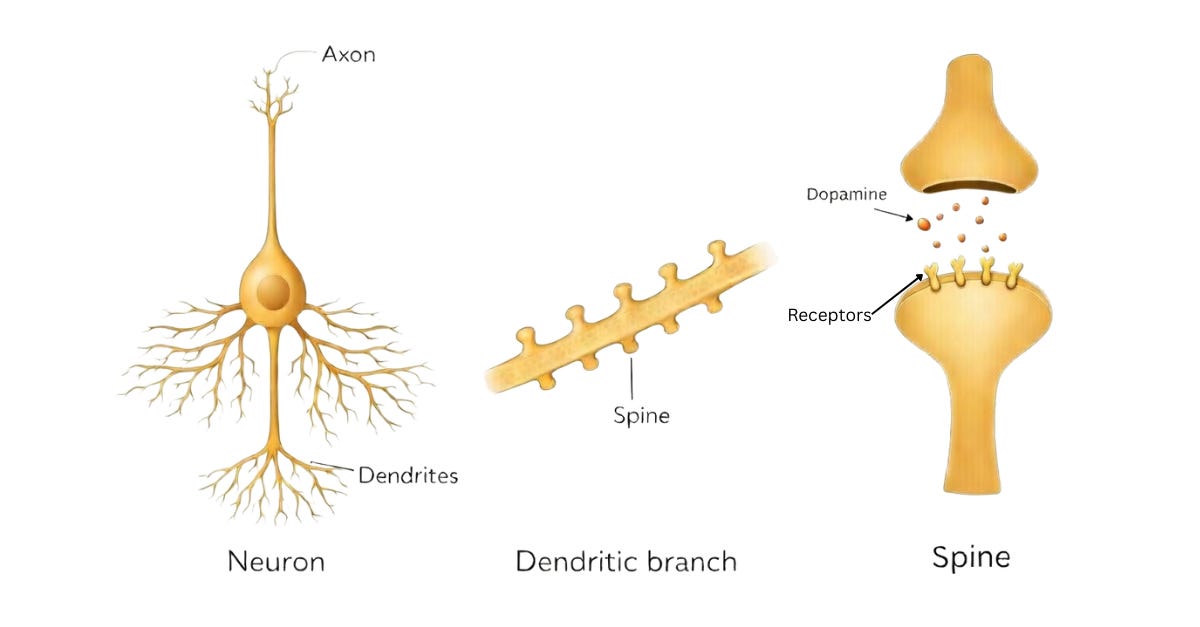
At any point in time, we have a steady, low level of dopamine being released amongst all the neurons in the motivation pathway of our brain (striatum).
All up and down the dendrite branches of these neurons are little satellite dishes (spines) that are covered in tiny chemical switches called dopamine receptors. In aggregate, these binary switches function like a sensor, activated by free-floating dopamine.
It doesn’t actually matter how much dopamine there is floating around the brain between neurons. What matters is how many receptors there are to sense it. If those satellite dishes are covered in them, the signal that gets through is nice and big. But if there are very few receptors, the signal that gets through is very weak.
And a weaker signal means a lower baseline level of motivation. Everything feels harder to start (and keep going) because there is less chemically-triggered momentum behind it.
In Japan, mine had all but disappeared.
Signs of a negative baseline
Short of injecting your brain with a radioactive tracer and then using a PET scanner, we can’t actually measure the number of dopamine receptors in your brain. But we can at least look for behavioural evidence of a negative dopamine baseline.
If you answer yes to any of the following, your baseline could be trending downwards — your motivation signal growing worryingly weak.
You find mundane activities (like a walk or cooking/cleaning) harder to start — there is no pull.
You find it very difficult to sustain effortful tasks and have a low tolerance for frustration.
You feel overwhelmed when you think about long-term goals you once had. They now seem out of reach and insurmountable.
You find it difficult to be present — to be content with the state of just being.
You find yourself reaching for stimulation not for pleasure but to feel normal — to escape.
You feel flat in situations that used to give you a mild positive emotion. There is little joy to be had in everyday moments.
You no longer feel an innate sense of curiosity or wonder. The urge to learn about something purely because it interests you has disappeared.
You find less pleasure in things that used to feel satisfying. You need more to get the same effect.
You feel a disproportionately greater pull for stimulation. Urges feel stronger.
While many of these signs overlap with other conditions like depression, the crucial combination of apathy, effort avoidance and a constant need for stimulation is a telltale sign of a negative dopamine baseline.1
How a baseline becomes negative
When we passively consume something — binge watch TV, binge food, doomscroll — we essentially subject our brain to an unnaturally rapid series of limbic spikes of dopamine.2 These spikes are mostly anticipatory spikes (wanting the next bite, wanting to keep scrolling, wanting the next) sprinkled with a few “reward” spikes (a particularly delicious bite, a satisfying scene on TV, a better-than-expected video clip). But crucially, these spikes all occur in an area of the brain in which dopamine was not designed to act in isolation.
When we actually use our brain during an activity, limbic spikes of dopamine can be adaptive. They’re the insight during learning. The PR during training. These limbic spikes are kept in a healthy range by top-down control.
That all changes during passive consumption, when top-down control goes relatively quiet.
During a mindless binge, the brain is essentially subjected to a “dopamine load” from all the successive spikes, without any top-down oversight to keep it in check.3 This dopamine load then ends up overloading the dopamine sensors it acts upon, and they retreat from the surface to escape the onslaught.4
As more receptors get pulled inwards (downregulate), the felt motivation signal gets weaker and the overall baseline — the motivation signal that gets through — starts to trend downwards.5
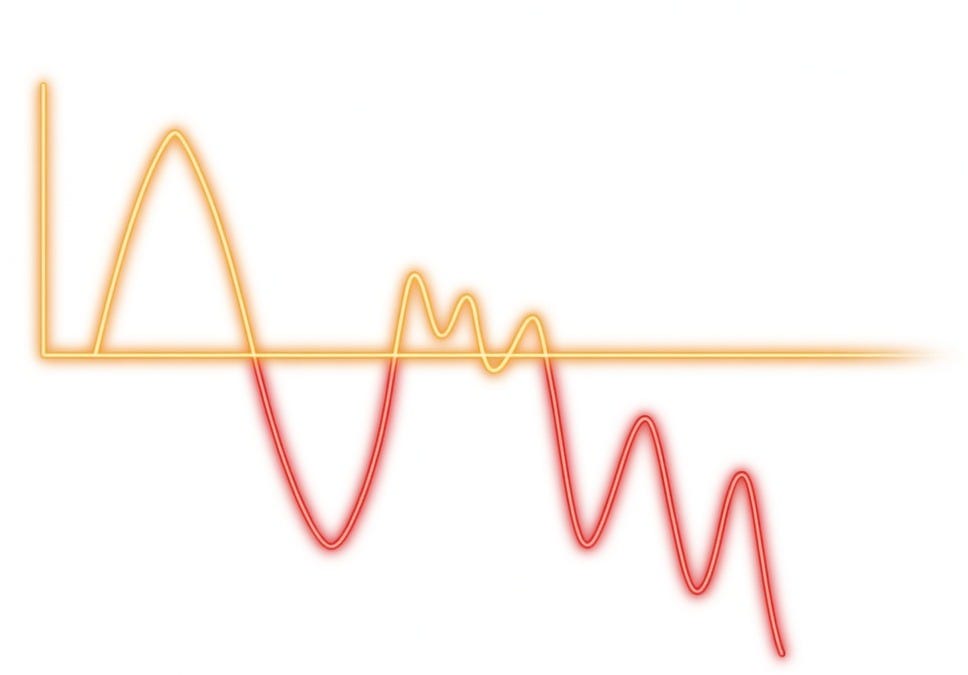
The brutal paradox is that even as the motivation signal becomes weaker, the pull of cravings stays strong, and can even feel stronger. (We’ll explore why this happens in the next essay.)
The slow descent
Maybe you answered “yes” to only some of the signs of a negative baseline. Or maybe you only feel that way some of the time.
And that might be entirely okay. Given adequate time and conditions for recovery, new receptors do sprout forth from their satellite dishes.6 They can grow back.
But on the other hand, it doesn’t mean your motivation signal isn’t slowly weakening over time — that the receptors growing back are never quite matching the number being continuously pulled inwards.
Because a negative baseline doesn’t happen all at once.
It can dip and recover like a bobbing cork but as the time between dips gets smaller, or there is less opportunity for recovery, that bobbing cork can turn into a sinking ship.
Every dopamine load you subject your brain to can increase the risk of receptors being pulled inwards. Especially if you are jumping from one stimulus to the next, never giving your brain the chance to recover from the stimulation.
The load doesn’t even need to be of a high amplitude. Drugs will of course get you there. But so can constant scrolling, or bingeing low-grade rewards like TV or food. It is the unnatural, incessant, unrelenting aspect of the load — and the lack of top-down control — that impacts the brain the most.
Holding you underwater
Before our trip to Japan, I was working 10 hour days at a startup. It was (to put it mildly) a stressful job of high responsibility and even higher stakes. When I got home, I would “check out” — bingeing food, then TV, then phone. Then I would go to bed, sleep poorly, wake up and do it all over again. Six days a week.
It isn’t just passive reward consumption that can cause dopamine receptors to be pulled inward — chronic stress does as well. In fact, chronic stress can also prevent full recovery as fewer receptors are restored to their satellite dishes.
All my little receptors were literally retreating to hide from an onslaught of limbic dopamine and stress.
Then I prevented them from re-emerging by getting poor sleep.
Slow-wave sleep is one of the most crucial periods during which receptors grow back. But if we don’t get enough of it, receptors that get pulled inwards during the day’s dopamine load don’t make it back to the surface before the next day begins.
The last of this depressing trio is inflammation, which can be caused by poor diet (check) and lack of exercise (also check). Inflammation affects the system from the opposite direction — by impacting baseline dopamine production.
So not only were my sensors less sensitive, but the baseline dopamine hitting them was reduced as well. (Dopamine released during stimulation is less affected — a cruel irony we’ll explore in the next essay.)
Chronic stress.
Poor sleep.
Inflammation.
A powerful triumvirate that grasps that bobbing cork, holding it underwater until it becomes a sinking ship.
Hiding in plain sight
If I asked you to spend the next 48 hours without any kind of stimulation — no phone, no songs, no TV. Just you and your thoughts. Does that thought make you uncomfortable? Does it terrify you?
You might have a negative baseline and not even know it.
It may be masked by the very stimulus that created it.
Before my trip to Japan, my brain was under a constant dopamine load that was hiding a baseline that was continuing to track downwards, like wreckage sinking towards the ocean floor.
When I entered conditions that removed some of that load, the true extent of my new brain state became clear.
When our lives are so heavily dominated by stimulation in so many different forms, all of those dopamine loads can temporarily mask the very mechanism that is driving us to continue to need that stimulation in the first place.
But it’s there in the solitary moments before you fall asleep. Or in the unease you feel when your phone dies. Or in the mounting effort it takes to climb out of bed in the morning.
Somewhere along my recovery journey, I remember reading this benign little statement and it stopped me in my tracks:
“I don’t drink coffee because I’m tired. I’m tired because I drink coffee.”
I didn’t binge to feel good. That phase ended very fast. I binged to feel normal.
You don’t seek stimulation because you lack motivation to do anything else. You lack motivation because you constantly seek stimulation.
That unmotivated state isn’t your personality.
It’s your new baseline.
And it is underwater.
Coming up for air
I started this essay on a rather depressing note, and it may seem like I’m about to end on one as well.
But my functionally negative dopamine baseline, kept submerged by years of accumulated load, has returned to normal.
I love to imagine the chemical activity of all the little receptors within my brain as a constellation in the night sky.
In Japan, that constellation was barely visible — like the washed-out dark sky viewed from a city as brightly lit as Tokyo itself.
But today the constellation of receptors in my brain must surely look like the kind of dense starry sky that is only visible from an untouched wilderness.
My dopamine receptors have grown back, and yours can too.

This essay is part one of a series on dopamine’s role in baseline motivation — how it is actually a perfectly functioning brain state, what drives it, and how it can be restored to levels that enrich your life.
Do you think yours is underwater? How much of your day is actually spent without stimulation?
If you’d like to go deeper into the dopamine machinery behind habits, craving, addiction and recovery, you might also find these essays useful:


References for this essay, and for the wider series, are available as a collection in the Research Library, specifically:
Note that if you have ADHD, you might answer yes to many of the signs in this list. And this makes sense – an ADHD brain often operates at a lower dopamine baseline than average.
Dopamine spikes are strongly linked to reward prediction error and are amplified under uncertainty and cue-driven environments. Variable reward schedules (like those found in scrolling or highly palatable food) are particularly effective at repeatedly triggering these spikes.
“Dopamine load” isn’t a formal term — it’s an abstraction of repeated phasic signalling without sufficient recovery.
In reality, this “shrinking back into the membrane” spans a spectrum, ranging from short-term desensitisation during acute binges to long-term downregulation after repeated binges. I’ve grouped them together here because, functionally, they both reduce how much of the dopamine signal gets through. In the next essay, I’ll unpack this distinction in more detail.
Reduced D2 receptor availability has been associated with lower motivation and reduced sensitivity to reward in both addiction and obesity literature.
Receptors can either be reinserted into the membrane or recycled, replaced by new receptors trafficked to the membrane in vesicles.
You are a brilliant storyteller. I felt like I could see the look on your husband’s face when it was obvious you weren’t having the NYE plans.
More importantly, your ability to make neuroscience accessible and readable to the layman is remarkable.
It’s a rare gem of an author that can hook readers on the finer points of dopamine spikes and negative baselines and leave them tongues out, wanting more.
Love the constellation imagery. Back on the brain being a microcosm of the universe.
Thankful your daughter opted for the snow day and not the doomed ship so many of us ride right into the iceberg.
Mindfulness, not escape, is the path. Purposeful boredom is the cure for the weary. Only after we regain the initial willpower to crawl out from under the covers to focus on simple ordinary activities do we begin to reconnect with our true purpose.