

You're not as focused as you think
How your ability to focus is undermined without your consent

Few pieces of neuroscience knowledge have made me make instant changes to my life like the one in this article.
Being academically driven from a young age, I have inadvertently spent my entire life honing the ability to focus on something at will. I can drop into a kind of flow state1 quite readily and stay immersed and on task for hours on end. (My beautiful daughters often cap this to an hour max, bless them.)
When I write at the local cafe around the corner, I am often oblivious to the ambient sounds of frothing milk, clattering coffee beans and the conversations of strangers, all of which combine into a peaceful susurrus of white noise around me.
I don’t say any of this to brag. I merely want to put into perspective the intrusive stimulus that finally bested me.
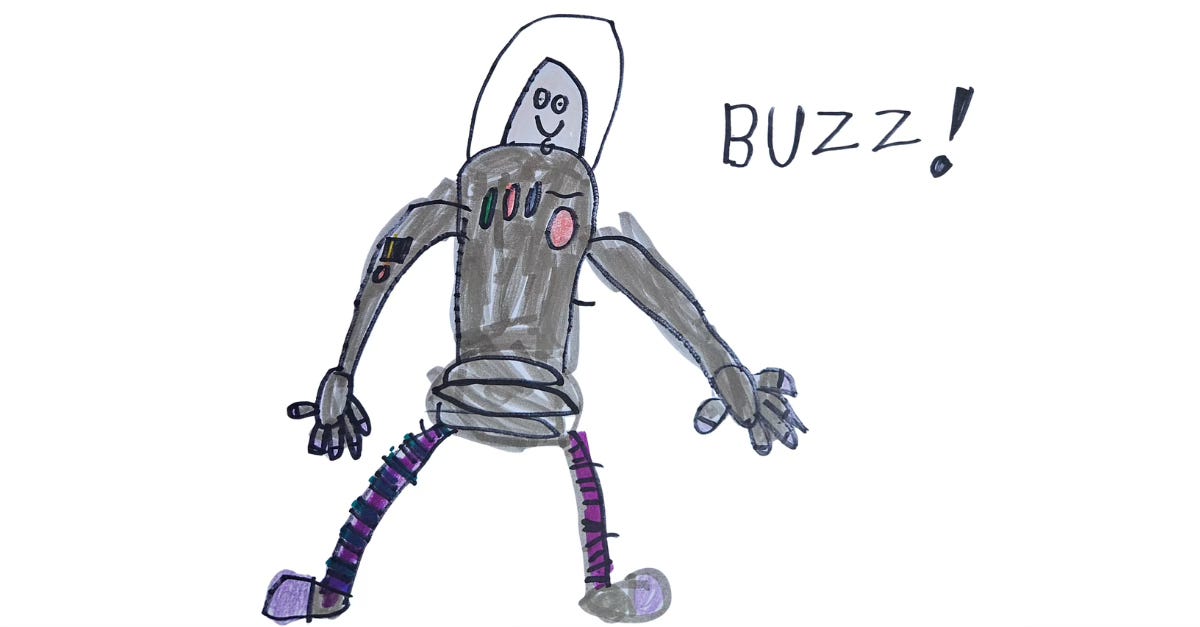
Toy Story 2.
When my daughters were recently sick, my scheduled writing blocks were among the first casualties (along with sanity and sunny dispositions). So I attempted to write some of this article while ensconced between my two sick little cherubs on the couch, Woody and Buzz wreaking their hidden havoc on the screen. But try as I might, I could not maintain my usual flow of concentration. The abrasive animations kept punching holes in my shield of focus like the iceberg scraping along the side of the Titanic.
We all have a limit to our capacity for focused attention and it’s different for everyone. It appears my limit is a 27-year-old (!) animated movie.
The scary thing is, I knew Toy Story 2 was depleting my focus. But there are hidden stimuli that our brain is constantly filtering out below conscious awareness, each one draining our cognitive battery like a power-hungry app left running in the background.
For many years, I assumed I was operating at peak cognitive performance (give or take) whenever my shield of focus snapped into place around me.
When I learned the contents of this article, I realised that was not at all true…
Your superpower
“Any sufficiently advanced technology is indistinguishable from magic,” — Arthur C Clarke
I view the brain’s ability to learn as the closest thing we have to a superpower. People who harness this power can achieve feats that seem like magic to those who don’t. But if there is any kind of Kryptonite that affects our learning superpowers, it is our modern environment.
To learn requires sustained attention: focus. And our entire modern environment is designed to steal from that focus, often depleting our cognitive resources behind the scenes without us even realising it.
This is your brain on task
When we sit down to do a task, unfortunately we can’t just flip a switch in our brain that says: “Flow state. Go.” The price for a fluid state of effortless attention must be paid up front, in the form of time under mental tension.
There are three major brain regions that allow us to focus on a task:2
The coordinator that holds the task in mind (dlPFC). This guy can stabilise about five different cortical circuits (chunks of knowledge) at a time, like a juggler deftly keeping five balls in the air.3
The suppressor that inhibits any active cortical circuits that are not relevant to the task (vlPFC). This guy erects a kind of protective shield around the juggler, preventing anything from knocking those balls out of the air. The peaceful shield of white noise that envelopes me at the cafe is the work of my suppressor.
The modulator that assesses whether there is something more important that requires attention (salience network).
At any point in time, our brain is being bombarded with an onslaught of sensory data. The modulator is constantly monitoring these internal and external stimuli, looking for the most important information — a sudden noise, lingering emotional content or even physical needs like hunger — and filtering out the rest. It calculates the value of each of these important things and weighs it against the value of what we’re currently focused on, all to answer one simple question:
Is it more valuable to hold attention where it is, or to switch?
When our attention is only loosely held, the value of keeping it there is low and the modulator will switch across at any sign of something even slightly valuable. This is why everything is distracting when you’re doing nothing.
But when we’re immersed in a task, the value is high, and it takes a much stronger stimulus for an attentional switch to be considered worth it. When a particularly strong stimulus is encountered but the task is still deemed the priority, the modulator will say “Incoming stimulus! Hold the line!” and the suppressor will crank up the power on the shield so that it is strong enough to prevent the intrusion.
Even at full power, Woody and Buzz still cracked my shield.
Getting in the zone
The decision to start focusing is a moment, but getting the brain into a focused state is a process.
When we first apply our attention to something, the value of the initiated task is still low. No time or effort has yet been invested. Everything distracts us.
Every “more important” stimulus (which is basically everything) — the email we need to answer, the lure of our phone, the niggling worry — pulls our attention from the task and we have to deliberately, effortfully, consciously keep trying to bring it back.
But there is something very beautiful that happens when we continue to bring attention back to a task. Dopamine will begin to slowly rise within those task-positive areas of the brain in which we need it most. Not the spiky, urge-like dopamine of the reward system (although little limbic spikes of encouragement can give you a boost once you start a hard task), but the slow and steady dopamine that fuels concentration, focus and creativity. This kind of dopamine acts as a signal-to-noise enhancer in our prefrontal cortex — it assists both the suppressor and coordinator in their jobs (with a little help from its neurochemical cousin, noradrenaline).4
The higher cortical dopamine climbs, the easier it is to focus and the higher the value of staying on task becomes. After about 10-20 minutes5 of effortful attention, cortical dopamine reaches optimal levels and we are officially “in the zone,” safely protected from external distractions by the suppressor’s shield.
Task: 1. Stimulus: 0.
Any limbic spikes of dopamine related to the task — an “aha” moment or a new level of skill unlocked — feel like a surge of euphoric motivation to continue and further increase the value of the task overall.6 It’s a beautiful system for learning.
Staying in the zone
Our cognitive capacity — the ability to stay focused for a sustained period of time — is finite. The coordinator, suppressor and modulator all draw from the same mental battery. When it's drained, the coordinator eventually starts to drop balls, the suppressor loses shield power and the modulator becomes less certain about the value of staying on task (and a little more trigger-happy to switch).7
There are two ways that our cognitive performance suffers — when a high-value stimulus penetrates the shield and competes for our attention, or the more insidious one: when a low-value stimulus is continually suppressed below conscious awareness, silently draining our resources, prematurely fatiguing our cognition.
High-value stimulus
We know that internally generated limbic spikes of dopamine are supportive because they’re directly tied to the task — they enhance our focus.
It’s the environmentally triggered ones that threaten it.
Whenever I sit down to write at home while my daughters play in the next room with their father, their giggles and squeals eventually fade into the background as my cortical dopamine rises and the suppressor powers up its shields. This essentially means my modulator has calculated the current value of the task as higher than their giggles (in terms of what deserves my present attention). But on more than one occasion (like when I’ve heard a sudden bang or a piercing wail), my attention is instantly yanked from the task with a big spike of dopamine (and likely noradrenaline).
Shield down. Balls scattered. Mum mode “on.” The value of my daughters’ safety always trumps the value of any present task.
But what about a stimulus that doesn’t deserve your attention, yet gets it all the same due to its enormous potential value? What could possibly be powerful enough to penetrate the shield and enter conscious awareness?
The sound of a notification will indeed penetrate your shield.8 Even the sight of your phone. Or the thought of it. The highly valuable, highly uncertain reward that it promises (coupled with any sensory intrusion) is something the modulator deems worthy of switching attention to.
When a stimulus invades our focus like this, we have two choices: accept the switch, check the proverbial notification and essentially end the current task, or fight the urge, ignore the notification and stay on task.
Neither option is great.
If we immediately check the notification, we are reinforcing that cue-reward loop and the modulator will assign that stimulus even higher value in future. Worse, we have essentially activated a new task within the brain. Even if the “checking” is only a brief moment in time (but is it ever, really?), those newly activated circuits (and associated neurochemicals) leave a residue that carries across to the resumed task.9 The switch back isn’t a clean one.
If we ignore the stimulus instead, what we’re actually doing is forcing the coordinator to allocate two precious balls to it, because we now have to hold the representation of the notification and the policy of not checking it in mind, in addition to the task (which is now allocated only three balls!).10
Paradoxically (cruelly even), the very maintenance of the additional goal not to check the notification is what keeps it alive as a recurrent stimulus, further weakening our shield.
Task: 0. Stimulus: 1.
Not only did my concentration suffer when I tried to write amidst a sensory barrage of animation, but my creativity suffered as well. (None of those words made it into the version of the article you are now reading.)
When you look at the stark reality of what a seemingly benign stimulus does to the brain during focus, it is no wonder people can’t concentrate properly when their silenced phone is sitting on the desk next to them,11 or when abrasive music is blasting in their ears.
If your work environment contains high-value stimuli or cues that point to them, you’ve already lost the attention war.
The most effective solution to prevent focus from being stolen is to engineer your work environment to be devoid of all salient stimuli in the first place.
Close unnecessary tabs. Hide your phone from sight (ideally in another room). Get rid of the snacks. Turn off any desktop notifications. (And never try to write while Toy Story 2 plays mere meters from your synapses.)
Erect a physical shield to protect your mental one.
Low-value stimulus
High-value stimuli that penetrate our focus may be the most disruptive distractions, but it’s the low-grade ones that are truly insidious.
Many of us have a number of high-value rewards in our lives — that first morning cup of coffee, the lure of the social media feed. (Some people even feel a dopamine cue spike of desire for their morning coffee while brushing their teeth the night before! Guilty, as charged.)
When a high-value reward has been indulged so many times, the cues that trigger a craving for it become so thoroughly conditioned that sometimes there is no external stimulus needed.12 It becomes a pervasive ever-present hum of desire within the mind. You don’t even need to see your phone to trigger the urge to check it. Just the barely conscious (or even below conscious) representation of the phone — the knowledge that it exists, that notifications may be accumulating, that the world is moving on without your participation — can be enough to trigger a response that your suppressor must continually handle.
And it’s not just the background hum of desire that silently drains shield power. Worrying thoughts and emotional remnants can be simmering away below the surface, siphoning off your cognitive battery.13
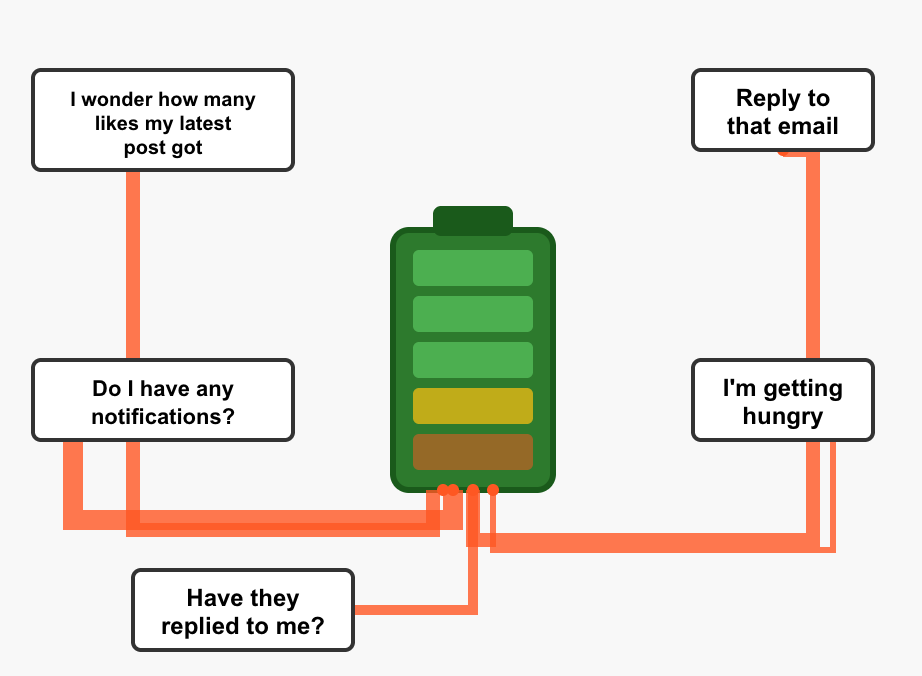
This has staggering implications, because it means that any heavily indulged high-value reward or pervasive anxiety in our lives is essentially a constantly running background app, silently compromising our ability to focus.
The question then becomes, “How do you know what is chewing through your resources if it’s all being handled below conscious awareness?”
I pondered this for a moment, but the answer was right there in front of me (and in the content above).
When we aren’t focused on a task, all stimuli (internal and external) are relevant. Which means that doing nothing — not focusing your attention on anything — is a chance to let what is usually a background hum in the mind come to the fore.
I did this myself. Every day for a week, I sat down after writing and just poured out my thought-stream for three minutes. What surfaced wasn’t peaceful silence, nor was it just the residue of ideas from writing. Underneath it all was a steady queue of half-formed worries, loose ends, little pulls of desire. Things I’d never noticed while busy suppressing them — background processes siphoning away my power without consent.
Your true cognitive potential
How much of your own cognitive power are you diverting towards these hidden processes without realising it? How much of your focused work is interrupted by salient stimuli?
Imagine if you could force-quit all those brain-draining apps.
Imagine if you could train your modulator not to switch across at the prospect of any reward.
Imagine the juggling feats your coordinator could achieve with the protected space and time to do so.
Your potential for focus is far greater than you think (just maybe not quite to infinity and beyond).
I encourage you to take your own three-minute inventory of any background apps you currently have running. The answer might surprise you.
In an upcoming essay, we’ll look at the protocols we can reverse engineer from the neuroscience in order to operate at peak cognitive performance. (I’ve been using them myself with great results.)
If you’d like to learn more about how your dopamine system was designed to work, how to recover from a negative dopamine baseline, or what neuroplasticity really is and where thoughts come from, you may want to check these out:


References for this essay, and for the wider series, are available as a collection in the Research Library, specifically:
Flow is a combination of optimal focus and a task that is tailored to the precise border between current skill level and challenge. In this article, I’m mostly referring to the optimal focus aspect of flow. The optimal task difficulty level is implied.
The dlPFC (dorsolateral prefrontal cortex) maintains working memory representations, the vlPFC (ventrolateral prefrontal cortex) provides cognitive inhibition, and the salience network (anchored by anterior insula and anterior midcingulate cortex) detects relevant stimuli and switches attention between networks.
The dlPFC can maintain approximately 4±1 items in working memory, often described as "chunks" of information that can be simple items or complex knowledge structures. This capacity limit was first established by Miller (1956) as "the magical number seven," later refined by Cowan (2001) to around four items.
Dopamine enhances signal-to-noise ratio in the PFC by strengthening task-relevant neural signals while reducing neural noise. This occurs through D1 receptor activation, which enhances NMDA currents and stabilises working memory representations. Noradrenaline from the LC works with dopamine to optimise the gain of prefrontal networks (Seamans and Yang 2004, Aston-Jones and Cohen 2005).
Cortical dopamine enhancement of prefrontal function follows an inverted-U curve, with optimal levels typically achieved after ~10-20 minutes of sustained cognitive effort (Arnsten 2009, Cools and D’Esposito 2011).
The salience network integrates information about stimulus importance and switches attention accordingly. Research shows the anterior insula responds to both external salience and internal reward signals, while the aMCC tracks effort and task engagement. During learning, increased connectivity between salience network regions and dopaminergic areas suggests these internal reward spikes influence ongoing attention allocation decisions (Uddin 2015, Shenhav et al. 2013, Krebs et al. 2012).
Sustained attention tasks show reduced performance over time due to fatigue in prefrontal regions. Neuroimaging studies demonstrate decreased activation in the dlPFC and vlPFC during prolonged cognitive effort, along with increased connectivity to DMN regions associated with mind-wandering. The aMCC, which monitors cognitive conflict, shows reduced sensitivity to task demands as fatigue increases (Boksem and Tops 2008, Langner and Eickhoff 2013).
Auditory and visual notifications reliably capture attention even during focused tasks. Stothart et al. (2015) found that phone notifications significantly disrupted performance on attention-demanding tasks, while Mark et al. (2008) showed that interruptions fragment attention and increase task completion time. The high reward value and unpredictability of notifications make them particularly potent attention-capturers. See Rosen et al. (2013) for effects of technology interruptions on cognitive performance.
“Task residue” refers to the persistence of task-related activation after switching to a new task, reducing performance on the subsequent task (Kiesel et al. 2010).
Attempting to suppress unwanted thoughts paradoxically keeps them active in working memory. Wegner's (1994) ironic process theory demonstrates that suppression requires both the suppressed content and the suppression instruction to be maintained simultaneously, consuming cognitive resources. This "white bear effect" has been replicated extensively, showing that trying not to think about something ironically makes it more accessible. Applied to notifications, ignoring the urge to check requires holding both the notification representation and the "don't check" rule in working memory (Wenzlaff and Wegner 2000).
Ward et al. (2017) found that cognitive performance was reduced when smartphones were present, even when silenced and face-down. However, Stothart et al. (2015) showed this effect was strongest for high phone attachment individuals, and recent replications have found more mixed results, suggesting individual differences in phone-related attentional capture.
Repeated cue-reward loops create conditioned responses that can trigger craving even without the reward present. This process involves dopamine release shifting from the reward itself to earlier and earlier predictive cues through temporal difference learning. Eventually, even subtle environmental contexts or internal representations can trigger conditioned responses (Berridge and Robinson 1998, Schultz 1998, O'Brien et al. 1998).
Worry and rumination consume working memory resources even when not directly relevant to current tasks. Anxious thoughts create ongoing cognitive load that reduces available capacity for focused attention. Neuroimaging studies show that worry activates prefrontal regions involved in executive control, creating competition with task-relevant processing (Eysenck et al. 2007, Moran 2016).
This is superb!
It's so true, excess stimuli, both internal and external makes my brain feel like its lugging a piano up a mountain.
So, I returned pencil and paper for doing my best thinking and writing.
My only regret is why didn't I do this all along? (What a Silly Goose.)
I love the title of this - it really captures the overconfidence of that part of our mind which is conscious awareness.
As you rightly say, there's a bit of us that says "don't worry, I got this, I can resist the phone". But that part is very consistently overwhelmed and defeated. The real mystery is why - after failing repeatedly - that part of the mind stays so sure of itself!